Let’s be honest: Caribbean Literature is some of the most beautiful—and most demanding—writing you will ever encounter. It’s a genre born from the intersection of three continents, shaped by the turquoise waters of the archipelago and the dark history of the plantation.
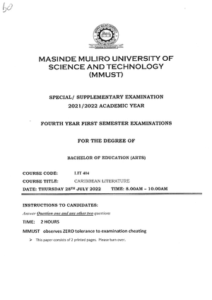
Below is the exam paper download link
Past Paper On Caribbean Literature For Revision
Above is the exam paper download link
When you sit down to revise, you aren’t just reading books; you’re untangling a web of identity, language, and exile. From Derek Walcott’s Homeric echoes to Jamaica Kincaid’s sharp critiques of colonialism, the syllabus is vast. The secret to a top grade? Understanding that in the Caribbean, the landscape is a character and language is a battlefield. To help you prep for the big day, we’ve tackled the essential questions that define the Caribbean canon.
The Revision Q&A: Cracking the Caribbean Code
Q: Why do examiners focus so much on ‘The Landscape’? In Caribbean Literature, the islands aren’t just a pretty backdrop. The sea is often a symbol of history—both a graveyard and a bridge. The “Middle Passage” is a recurring theme. When you’re answering a question about setting, don’t just describe the beach; talk about how the land reflects the character’s state of mind. Use the term “The Aesthetics of Resistance” to describe how writers reclaim their islands from colonial postcards.
Q: How do I handle ‘Creole’ and ‘Nation Language’ in my analysis? This is where students often lose marks by being too simplistic. Caribbean writers often use a “linguistic continuum.”
-
Standard English: Often represents the formal, colonial education.
-
Nation Language (Patois/Creole): Represents the authentic, lived experience of the people. If a character switches between the two, they are likely navigating two different worlds. Mentioning Kamau Brathwaite’s concept of “Nation Language” will show the examiner you’ve done your deep-dive research.
Q: What is the significance of ‘The Calypso’ and ‘Oral Tradition’ in written texts? Caribbean literature is deeply musical. Many novels and poems borrow the rhythm of Calypso, Reggae, or the oral folktales of Anansi the Spider. If you see a repetitive structure or a call-and-response pattern in a poem, point it out! It’s a way of bringing the oral tradition into the written form, preserving a culture that was once forbidden.
Q: How do I approach the theme of ‘Exile and Return’? Many Caribbean authors wrote their greatest works while living in London or New York (think of George Lamming’s The Emigrants). This “Outsider” perspective is crucial. Examiners want you to discuss the Double Consciousness—feeling like you don’t fully belong in the metropole, but feeling like a stranger when you return home to the islands.
The Power of the Past Paper: Your Exam Compass
Reading Omeros is a life-changing experience; writing a 20-mark essay on it in 45 minutes is a technical challenge. Caribbean Literature papers often require you to bridge the gap between history and art.
By downloading our Caribbean Literature past paper, you will:
-
Master Comparative Analysis: Learn how to link a St. Lucian poem to a Barbadian novel through shared themes of “Mimicry.”
-
Practice Contextualization: See how to link a text’s anger to specific historical events like the Haitian Revolution or the arrival of the Empire Windrush.
-
Refine Your Critical Vocabulary: Practice using terms like Hybridity, Liminality, and Syncretism in the right context.
Download Your Revision Resource
Ready to stop skimming and start analyzing? Don’t let the complexity of the “Middle Passage” intimidate you. The best way to build your confidence is to see the questions before the clock starts ticking in the hall. Use the link below to download a full Caribbean Literature past paper and start your practice.
[Click Here to Download the Caribbean Literature Past Paper for Revision]

A Quick Parting Tip: The ‘History’ Rule
Derek Walcott famously wrote, “History is amnesia.” In Caribbean literature, the characters are often trying to remember a past that was erased. Whenever you’re analyzing a text, ask: What is being remembered here, and what is being forgotten? If you can identify the “silences” in a story, you are reading at a University level.