Let’s be real: Drama and Film Studies is probably the only subject where “watching Netflix” can technically count as homework—but only if you know what you’re looking for. When the exam paper hits your desk, it won’t ask you if the movie was “good.” It will ask you how the low-angle shot established the villain’s power or how the Brechtian alienation effect forced the theatre audience to stop eating their popcorn and start thinking.
Below is the exam paper download link
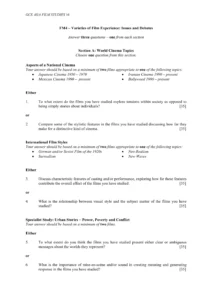
Past Paper On Drama And Film Studies For Revision
Above is the exam paper download link
The bridge between the stage and the screen is built on storytelling, but the tools are completely different. To help you stop blurring the two, we’ve tackled the big questions that show up in almost every Drama and Film Studies revision cycle.
The Revision Q&A: Thinking Like a Critic
Q: How do I handle ‘Mise-en-Scène’ without just listing things in the room? Mise-en-scène is “everything in the frame.” In an exam, don’t just say there was a lamp on the table. Explain why. Is the lighting harsh and expressionistic to show the character’s fractured mind? Is the costume color contrasting with the background to show isolation? In both drama and film, every object is a choice. If you can explain the symbolism behind the clutter, you’ve secured the marks.
Q: What is the biggest difference between ‘Stage Acting’ and ‘Screen Acting’? Scale. On stage, you are acting for the person in the very back row; your gestures must be large, and your voice must project. On screen, the camera is “the front row.” A tiny flicker of an eyelid can convey more than a shouted monologue. If a past paper asks about Performance Style, make sure to mention the “proximity of the audience.”
Q: How do I analyze ‘Cinematography’ like a pro? Stop looking at the actors and start looking at the camera.
-
The Close-Up: Forces intimacy or claustrophobia.
-
The Dutch Angle: Creates a sense of unease or madness.
-
The Tracking Shot: Puts the audience “inside” the movement. In your revision, practice identifying these in five-minute clips. If you can name the shot and its psychological impact, you’re thinking like a director.
Q: What is ‘The Auteur Theory’ and why does it keep coming up? The Auteur Theory suggests the director is the “author” of the film, with a recognizable style that carries across different movies (think Hitchcock or Tarantino). In Drama, this is similar to a Visionary Director like Stanislavski or Artaud. Examiners want to see if you can identify a creator’s “signature” through their recurring themes and technical choices.
The Power of the Past Paper: Your Director’s Cut
You can read about “Montage” for hours, but you won’t know if you’ve mastered it until you try to analyze a storyboard or a script excerpt under pressure. This is where the past paper becomes your best friend.
By downloading our Drama and Film Studies past paper, you will:
-
Master Technical Terminology: Practice using words like diegetic sound, jump-cut, proscenium arch, and blocking in the right context.
-
Refine Your Comparative Skills: Many papers ask you to compare a theatrical production to its film adaptation. You’ll learn how to discuss what is “lost” or “gained” in the transition.
-
Perfect Your Essay Structure: Film essays require a balance of technical analysis and thematic discussion.
Download Your Revision Resource Here
Ready to take your analysis from the “background” to “center stage”? Don’t leave your grades to a “final cut” you haven’t rehearsed. Use the link below to download a full past paper designed to test your knowledge of both the spotlight and the lens.
[Click Here to Download the Drama and Film Studies Past Paper for Revision]

A Quick Parting Tip: The ‘Rule of Three’ in Sound
When analyzing sound, always check for three things: Dialogue, Sound Effects (Foley), and Music. In film, these are layered in post-production. In drama, they are often live. If you can explain how the “soundscape” changes the mood of a scene, you’re hitting that 1% of students who remember that film and theatre are also auditory experiences!