Let’s be honest: for most education students, the “Research Methods” unit is the one that causes the most sleepless nights. It’s the moment the syllabus shifts from the art of teaching to the cold, hard science of data. Suddenly, you aren’t just talking about lesson plans; you’re talking about null hypotheses, stratified sampling, and triangulation.
Below is the exam paper download link
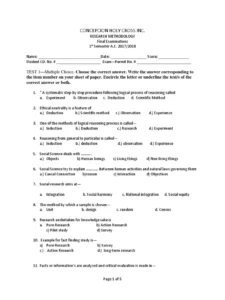
Past Paper On Educational Research Methods For Revision
Above is the exam paper download link
But here’s the secret: Research methods isn’t about memorizing math. It’s about logic. It’s about learning how to ask a question so clearly that the answer becomes undeniable. Whether you are preparing for a mid-term or your final thesis defense, the best way to move from “confused” to “competent” is to see how these theories are applied in real exam scenarios.
The Revision Q&A: Cracking the Research Code
Q: What is the real-world difference between Qualitative and Quantitative research? Think of it like this: Quantitative research wants to know how many. It uses numbers, surveys, and statistics to find patterns across a large group. Qualitative research wants to know why. It uses interviews and observations to get the deep, “thick description” of a human experience.
In your exam, if you’re asked to choose a method for “improving school spirit,” you’d likely use both—that’s called Mixed Methods.
Q: Why do examiners focus so much on ‘Action Research’ in education? Because Action Research is designed for the classroom. Unlike traditional research where a scientist watches from a distance, Action Research is done by the teacher, for the teacher. It follows a cycle: Plan, Act, Observe, Reflect. If a past paper asks how a teacher can solve a specific reading problem in their class, Action Research is almost always your correct answer.
Q: How do I distinguish between ‘Reliability’ and ‘Validity’? This is a classic “trap” question.
-
Reliability is about consistency. If you give the same test twice, do you get the same result?
-
Validity is about accuracy. Does the test actually measure what it claims to measure? A scale that always weighs you as 5kg too light is reliable (consistent), but it isn’t valid (accurate).
Q: What are the ‘Big Three’ ethical considerations in educational research? You can’t just walk into a school and start poking around. Examiners look for these three keywords:
-
Informed Consent: Did the participants (and parents) agree to be part of the study?
-
Anonymity/Confidentiality: Are the students’ identities protected?
-
Right to Withdraw: Can they quit the study at any time without penalty?
The Power of the Past Paper: Why Practice is Paramount
You can read a textbook on “Sampling Techniques” until you’re blue in the face, but until you try to justify why you chose Purposive Sampling over Random Sampling in a timed essay, you haven’t truly revised.
By downloading our Educational Research Methods past paper, you will:
-
Identify Question Patterns: You’ll notice that questions on Sampling and Data Analysis appear in almost every single paper.
-
Refine Your Technical Vocabulary: Practice using terms like Likert Scale, Case Study, and Phenomenology in the right context.
-
Master Data Interpretation: Many papers provide a small set of data or a graph and ask you to draw a conclusion. Practicing this prevents “brain-freeze” during the actual exam.
Download Your Revision Material Here
Ready to stop guessing and start calculating? Don’t leave your research marks to chance. Use the link below to download a curated Educational Research Methods past paper that covers everything from foundational philosophy to modern data software.
[Click Here to Download the Educational Research Methods Past Paper]

A Quick Parting Tip: The ‘Triangulation’ Trick
Whenever you are asked how to make a study “stronger” or more “trustworthy,” use the word Triangulation. It simply means using more than one source of data (e.g., a survey and an interview). It’s the “silver bullet” answer for questions about increasing the rigor of your research!