Let’s be honest: Theatre Arts is one of the most misunderstood subjects in academia. To the outsider, it looks like “playing pretend.” But for those of us in the trenches, we know it’s a rigorous blend of psychology, history, engineering, and raw emotional discipline.
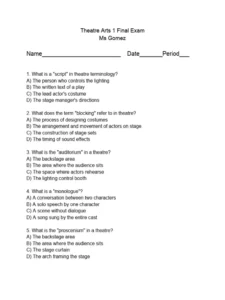
Below is the exam paper download link
Past Paper On Theatre Arts For Revision
Above is the exam paper download link
When you’re sitting for a Theatre Arts exam, you aren’t just a student; you’re a director, a lighting designer, and a critic all at once. The sheer breadth of the syllabus—from the dusty amphitheatres of Sophocles to the “Poor Theatre” of Grotowski—can be overwhelming. The secret to passing? You have to stop reading and start visualizing. To help you find your mark, we’ve tackled the big questions that define the grading curve.
The Revision Q&A: Mastering the Stage
Q: How do I distinguish between ‘Realism’ and ‘Naturalism’ in an exam answer? This is a favorite “trick” question. Think of Realism as a mirror to society; it looks like real life but is structured to make a point (think Henrik Ibsen). Naturalism is like a scientist’s microscope; it’s “extreme realism” that focuses on how heredity and environment control human behavior. If a question asks about the “Fourth Wall,” they are almost always testing your knowledge of these two movements.
Q: What is the ‘Stanislavski Method’ actually asking of an actor? Forget the Hollywood “Method” stereotypes. Stanislavski wanted Psychological Realism. If you get a question on this, focus on terms like the “Magic If” (What would I do if I were in this situation?) and “Given Circumstances.” Examiners want to see that you understand acting as an internal process, not just funny voices and big gestures.
Q: Why does ‘Stagecraft’ carry so many marks in a theory paper? Because a play is nothing without its “container.” You need to know your stage types.
-
Proscenium Arch: The traditional “window” stage.
-
Thrust Stage: The audience is on three sides (great for intimacy).
-
Arena/Theatre-in-the-round: The audience surrounds the actors entirely. In your exam, if you’re asked to design a set, explain why your choice of stage suits the mood of the play.
Q: How do I handle ‘Aristotelian Tragedy’? Aristotle’s Poetics is the “Bible” of theatre exams. Memorize the big six elements: Plot, Character, Thought, Diction, Song, and Spectacle. If you’re analyzing a tragedy, look for the Hamartia (the hero’s fatal flaw) and explain how the ending achieves Catharsis (the emotional release of the audience).
The Power of the Past Paper: Your Backstage Pass
You can read about “Blocking” a scene for hours, but you won’t know if you’ve mastered it until you see a script excerpt and a blank stage diagram. That is where the past paper comes in.
By downloading our Theatre Arts past paper, you will:
-
Decode Director’s Notes: Practice interpreting stage directions. Why did the playwright specify “dim blue lighting”?
-
Refine Your Technical Vocabulary: Move beyond saying “the stuff on stage.” Use words like flats, gels, cyclorama, and blocking.
-
Master Time Management: Drama essays can get long-winded. Practicing helps you learn how to argue a point about “Brechtian Alienation” in twenty minutes flat.
Download Your Revision Resource
Ready to take your bow? Don’t let the “curtain call” of your finals catch you unprepared. The best way to build your confidence is to tackle the questions that have challenged students for years. Use the link below to download a comprehensive Theatre Arts past paper and start your “tech rehearsal” today.
[Click Here to Download the Theatre Arts Past Paper for Revision]

A Quick Parting Tip: The ‘Spectator’ Perspective
Whenever you’re answering a question about set design or acting style, always mention the Audience Impact. Theatre is a two-way street. If you explain how a certain lighting choice makes the audience feel uncomfortable or how a monologue “breaks the fourth wall” to involve the viewer, you are showing the examiner that you understand the true purpose of the art form!