Let’s be honest: Chemistry is a daunting subject for many students. As a teacher, you aren’t just passing on facts; you are a translator. You have to take abstract concepts—like the invisible dance of electrons or the thermodynamic chaos of an exothermic reaction—and make them visible, safe, and exciting.
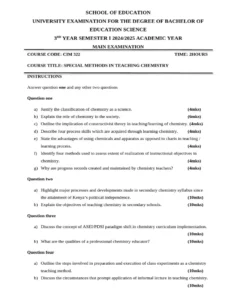
Below is the exam paper download link
Past Paper on Methods Of Teaching Chemistry For Revision
Above is the exam paper download link
Methods of Teaching Chemistry isn’t just about knowing the Periodic Table; it’s about knowing how to spark that “aha!” moment in a crowded classroom. Whether you’re a student-teacher preparing for your final board exams or a veteran looking to refresh your pedagogy, mastering the “how” is just as vital as the “what.” To help you prepare for your finals, we’ve broken down the high-frequency questions found in recent chemistry education past papers.
The Revision Q&A: Cracking the Chemistry Pedagogy Code
Q: What is the ‘Heuristic Method’ and why is it effective in a lab setting? The word Heuristic comes from the Greek “heuriskein,” meaning “to find.” In this method, the teacher places the student in the position of an original discoverer. Instead of telling them that an acid turns litmus paper red, you provide the tools for them to find out.
In your exam, if you’re asked how to foster “scientific temper,” the Heuristic method is your best answer. It shifts the student from a passive listener to an active investigator.
Q: How do you use the ‘5E Instructional Model’ to plan a lesson on Chemical Bonding? The 5E model is the gold standard for inquiry-based science. In a past paper, you might be asked to draft a lesson plan using these stages:
-
Engage: Start with a “magic” trick—perhaps a balloon sticking to a wall—to spark curiosity about charges.
-
Explore: Let students build molecular models using toothpicks and clay.
-
Explain: Introduce the formal terms like “Covalent” and “Ionic.”
-
Elaborate: Ask them to predict the bonding in a new substance.
-
Evaluate: A quick exit ticket or quiz.

Q: Why is ‘Demonstration’ often preferred over ‘Individual Practical’ for certain reactions? This is a classic “Pedagogy vs. Practice” question. While hands-on work is great, the Lecture-Demonstration method is used when:
-
The chemicals are too dangerous or expensive for 40 students to handle.
-
The apparatus is complex and requires precise setup.
-
The reaction is too fast or too slow to be managed in small groups.
-
The goal is to show a specific “discrepant event” that requires a clear, unobstructed view.
Q: How do you address ‘Misconceptions’ in Chemistry, such as the idea that atoms are ‘alive’? Chemistry is full of abstract models that students often take literally. In an exam, discuss Conceptual Change Theory. This involves identifying the misconception, creating “cognitive conflict” (showing them evidence that contradicts their wrong idea), and then providing a more plausible scientific model.


The Power of the Past Paper: Your Tactical Roadmap
You can read about “Pedagogical Content Knowledge” (PCK) all day, but teaching is a practical craft. You need to know how to design a Scheme of Work or justify a Safety Protocol for a volatile experiment under a 45-minute timer.
By downloading our Methods of Teaching Chemistry past paper, you will:
-
Master Lab Management: Practice answering questions on the “Three-Tier Lab Safety” approach.
-
Refine Your Assessment Skills: Learn how to write “Bloom’s Taxonomy” aligned questions specifically for the sciences.
-
Spot the Trends: You’ll notice that questions on Green Chemistry and Virtual Lab Simulations are becoming standard in 2026 papers.
Download Your Revision Material Here
Ready to move from a student of chemistry to a master of teaching? Don’t leave your pedagogy grades to “reaction time” alone. The best way to build your confidence is to tackle the instructional puzzles that have challenged educators for decades. Use the link below to download a curated past paper.
[Click Here to Download the Methods of Teaching Chemistry Past Paper PDF]

A Quick Parting Tip: The ‘Macroscopic to Microscopic’ Rule
Whenever you are asked how to introduce a new topic, mention the Chemistry Triangle (Johnstone’s Triangle). Always start with the Macroscopic (what they can see), move to the Sub-microscopic (atoms and molecules), and finally the Symbolic (chemical equations). Mentioning this specific framework is a surefire way to get a distinction!
Back to Mpya News Home page: Education, Fashion, Law, business and sports

Last updated on: February 6, 2026
New information gained / new value takehome
- ” Elaborate: Ask them to predict the bonding in a new substance.
- Refine Your Assessment Skills: Learn how to write “Bloom’s Taxonomy” aligned questions specifically for the sciences.
- Back to Mpya News Home page: Education, Fashion, Law, business and sports Last updated on: February 6, 2026Mpya News Sitemap .
- News Education Rankings Reference 2: SNHU Distance Learning Reference 3: GCU University Programs Photo credit: instagram.
This content was developed using AI as part of our research process. To ensure absolute accuracy, all information has been rigorously fact-checked and validated by our human editor, Collins Murithi.

