Let’s be honest: Business Studies is a dynamic, living subject. It’s not just about balancing columns in a ledger; it’s about entrepreneurship, consumer behavior, and global economics. As a teacher, your challenge is to prevent these vital concepts from becoming “just another chapter” in a textbook. You have to turn your classroom into a marketplace of ideas.
Below is the exam paper download link
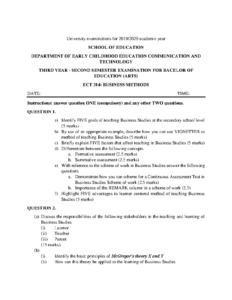
Past Paper On Methods Of Teaching Business Studies For Revision
Above is the exam paper download link
Methods of Teaching Business Studies (Pedagogy) is the bridge that connects theoretical commerce to student understanding. Whether you’re a student-teacher prepping for your final professional exams or an educator looking to modernize your delivery, mastering these instructional strategies is the key to success. To help you get exam-ready, we’ve tackled the high-frequency questions that consistently appear in recent past papers.
The Revision Q&A: Cracking the Business Pedagogy Code
Q: Why is the ‘Case Study Method’ considered the gold standard in Business Education? Business doesn’t happen in a vacuum. A case study takes a real-world scenario—like the rise of a local startup or the bankruptcy of a retail giant—and asks students to analyze the “why.”
In an exam, if a question asks how to develop “analytical skills,” the Case Study is your best answer. It forces students to move beyond memorizing definitions of “liquidity” and makes them apply the concept to a struggling business.
Q: How do you use ‘Project-Based Learning’ (PBL) to teach Entrepreneurship? Entrepreneurship cannot be learned solely from a chalkboard. PBL involves giving students a task, such as “Design a business plan for a sustainable product.”
-
The Benefit: It integrates accounting, marketing, and management into one activity.
-
The Exam Tip: When discussing PBL in an exam, emphasize the role of the teacher as a facilitator rather than a lecturer.
Q: What is the difference between ‘Inductive’ and ‘Deductive’ approaches in teaching Accounting?
-
-
Deductive: You give the rule first (e.g., “Assets = Liabilities + Owner’s Equity”) and then provide examples. This is faster but less engaging.
-
Inductive: You show various transactions first and lead the students to “discover” the accounting equation themselves. In your revision, practice justifying which method works best for complex topics like “Inflationary Trends” versus simple “Double Entry.”
-
Q: How do ‘Simulation Games’ and ‘Role Play’ enhance a lesson on Insurance or Banking? Abstract concepts like “Indemnity” or “Collateral” come to life when students have to act them out. Role-playing a bank loan interview or an insurance claim dispute helps students understand the emotional and ethical sides of business. Past papers often ask you to describe a specific activity for a sub-topic; always mention the “Debrief” phase where you link the game back to the syllabus.
The Power of the Past Paper: Your Tactical Roadmap
You can read about “Constructivism” all day, but teaching is a practical craft. You won’t know if you’ve truly mastered Pedagogical Content Knowledge (PCK) until you try to draft a marking scheme or a Table of Specifications under a 45-minute timer.
By downloading our Methods of Teaching Business Studies past paper, you will:
-
Master Assessment: Practice writing “Application-Level” questions that test a student’s ability to solve business problems.
-
Refine Your Resource Use: Learn how to justify the use of a “Flow Chart” versus a “Statistical Graph” in a trade lesson.
-
Spot the Trends: You’ll notice that questions on ICT Integration (using spreadsheets in class) and Green Business policy-page-at-mpya-news/" title="Ethics">Ethics are huge in 2026.
Download Your Revision Material Here
Ready to move from a student of business to a master of instruction? Don’t leave your pedagogy grades to “market fluctuations.” The best way to build your confidence is to tackle the instructional puzzles that have challenged educators for decades. Use the link below to download a curated past paper.
[Click Here to Download the Methods of Teaching Business Studies Past Paper PDF]
A Quick Parting Tip: The ‘Local Environment’ Rule
Whenever you’re asked how to make a Business Studies lesson more relevant, always suggest using Local Resources. Mentioning a visit to a nearby supermarket to study “Stock Control” or inviting a local entrepreneur for a talk shows the examiner you understand how to make the subject “authentic.”
Back to Mpya News Home page: Education, Fashion, Law, business and sports
Last updated on: February 6, 2026
New information gained / new value takehome
- Whether you’re a student-teacher prepping for your final professional exams or an educator looking to modernize your delivery, mastering these instructional strategies is the key to success.
- ” The Benefit: It integrates accounting, marketing, and management into one activity.
- The Exam Tip: When discussing PBL in an exam, emphasize the role of the teacher as a facilitator rather than a lecturer.
- ”Back to Mpya News Home page: Education, Fashion, Law, business and sports Last updated on: February 6, 2026Mpya News Sitemap .
- News Education Rankings Reference 2: SNHU Distance Learning Reference 3: GCU University Programs Photo credit: instagram.
This content was developed using AI as part of our research process. To ensure absolute accuracy, all information has been rigorously fact-checked and validated by our human editor, Collins Murithi.