Let’s be honest: when you first stepped into the world of education, you probably thought about lesson plans and child psychology, not macroeconomic trends and cost-effectiveness ratios. But the moment you look at a school as an investment, you enter the fascinating, often cold-blooded world of the Economics of Education.
Below is the exam paper download link
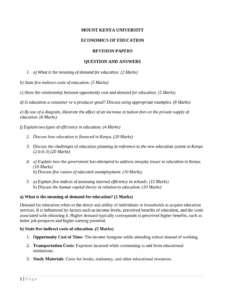
Past Paper On Themes In Economics Of Education For Revision
Above is the exam paper download link
Whether it’s a government deciding between building ten primary schools or one university, or a parent deciding if a Master’s degree is worth the debt, economics is the silent conductor of the educational orchestra. To help you prepare for your upcoming exams, we’ve tackled the big themes that reappear year after year in past papers.
The Revision Q&A: Thinking Like an Educational Economist
Q: Why does the ‘Human Capital Theory’ always seem to be the first question? Because it is the bedrock of the subject. Developed by thinkers like Gary Becker and Theodore Schultz, this theory treats education as an investment that increases an individual’s productivity. In an exam, don’t just say “education helps people get jobs.” Use the technical edge: explain that education embeds skills and knowledge into the worker, shifting the national production function outward.
Q: What is the ‘Signaling vs. Human Capital’ debate? This is a favorite “critique” question. While Human Capital Theory says education gives you skills, the Signaling (or Screening) Theory argues that education simply identifies people who are already smart or disciplined. A degree is like a badge; it doesn’t necessarily change the wearer, it just signals their value to an employer. If you get an essay question on the “Value of a Degree,” comparing these two views is your ticket to a top grade.
Q: How do I explain ‘Externalities’ in education without getting confused? Think of an externality as a “spillover.” When you get educated, you benefit (higher salary), but society also benefits in ways you aren’t paid for.
-
Positive Externalities: Lower crime rates, better public health, and a more informed voting population. Because individuals don’t always consider these “social benefits,” they might under-invest in education, which is why governments must provide subsidies.
Q: What is ‘Internal Efficiency’ in a school system? This isn’t about money; it’s about flow. Examiners look for keywords like wastage, repetition, and dropout rates. A school system is internally efficient if it moves the maximum number of students through the cycle in the minimum amount of time. If a past paper asks how to improve a struggling school district, look for ways to reduce the “repetition rate.”
The Power of the Past Paper: Your Secret Revision Weapon
Reading a textbook gives you the “what,” but a past paper gives you the “how.” The Economics of Education is a technical subject that requires you to apply theory to real-world data under a ticking clock.
By downloading our Themes in Economics of Education past paper, you will:
-
Master the Vocabulary: Practice using terms like Rate of Return (RoR), Opportunity Cost, and Educational Inflation in the right context.
-
Refine Your Data Analysis: Many papers provide a table of “Earnings by Level of Education” and ask you to interpret it. Doing this at home first prevents panic in the exam hall.
-
Identify Question Trends: You’ll notice that themes like Gender Equity and Funding Models (Vouchers vs. Grants) are hot topics in 2026.
Download Your Revision Resource Here
Ready to move from a student to a strategist? Don’t leave your performance to the “market forces” of chance. The best way to build your confidence is to tackle the fiscal and philosophical problems that have challenged students for years. Use the link below to download a curated past paper on the Themes in Economics of Education.
[Click Here to Download the Themes in Economics of Education Past Paper]

A Quick Parting Tip: The ‘Opportunity Cost’ Factor
Whenever you are asked why a student might choose not to go to university even if tuition is free, the answer is almost always Opportunity Cost. By being in a classroom, they are “giving up” the wages they could have earned in a full-time job. Mentioning this “hidden cost” proves to the examiner that you truly understand economic logic!