Let’s be honest: in the world of public policy and project management, “good intentions” don’t pay the bills. Every bridge built, every vaccination program launched, and every new school funded has to answer one cold, hard question: Is it worth it?
Below is the exam paper download link
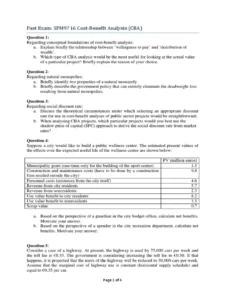
Past Paper On Cost Benefit Analysis And Economic Appraisal For Revision
Above is the exam paper download link
This is where Cost-Benefit Analysis (CBA) and Economic Appraisal come in. It’s the art of weighing the measurable costs against the often-invisible benefits to society. If you’re preparing for an exam in this field, you know it’s a minefield of discount rates, opportunity costs, and sensitive variables. To help you navigate the jargon, we’ve tackled the most frequent hurdles found in recent past papers.
The Revision Q&A: Thinking Like an Appraiser
Q: What is the fundamental difference between ‘Financial Analysis’ and ‘Economic Analysis’? This is a classic “Question 1” in most papers. Financial Analysis looks at the project through the eyes of a business owner—it cares about cash flow and private profit. Economic Analysis (or CBA) looks through the eyes of society. It includes “externalities”—like reduced pollution or saved travel time—that don’t show up on a bank statement. In your exam, always specify whose perspective you are taking.
Q: Why do we ‘Discount’ future benefits? Isn’t a dollar always a dollar? In CBA, time is money. A thousand dollars today is worth more than a thousand dollars ten years from now because of the Social Discount Rate. We discount to account for “time preference” and the “opportunity cost of capital.” If your exam asks you to calculate the Net Present Value (NPV), remember: if the NPV is greater than zero, the project is a “go.”
Q: How on earth do you put a price on a human life or a clean river? This is the “Shadow Pricing” challenge. Since there is no “market” for clean air, appraisers use techniques like Contingent Valuation (asking people what they’d pay) or Hedonic Pricing (looking at how park views increase house prices). When writing your essay, acknowledge that these are estimates, but explain that they are necessary to ensure “intangibles” aren’t ignored.
Q: What is ‘Sensitivity Analysis’ and why should I include it in my answer? CBA is based on assumptions. What if the bridge costs 20% more than expected? What if fewer people use it? Sensitivity analysis tests how “robust” your conclusion is by changing these variables. Mentioning this in an exam shows the marker you understand that real-world data is messy and uncertain.
The Power of the Past Paper: Your Calculation Roadmap
You can read about “Opportunity Cost” for hours, but Economic Appraisal is a technical skill. You need to know how to set up a table, apply a discount factor, and interpret an Internal Rate of Return (IRR) under a strict 45-minute timer.
By downloading our CBA and Economic Appraisal past paper, you will: * Master the Math: Practice the step-by-step process of calculating the Benefit-Cost Ratio (BCR).
-
Refine Your Technical Vocabulary: Move beyond “expenses” and start using terms like Sunk Costs, Transfer Payments, and Consumer Surplus.
-
Identify Trends: You’ll notice that questions on Environmental Impact Appraisals are becoming standard in modern papers.
Download Your Revision Resource Here
Ready to turn your spreadsheets into a top-tier grade? Don’t leave your marks to chance. The best way to build your confidence is to tackle the complex decision-making problems that have challenged students for years. Use the link below to download a curated CBA and Economic Appraisal past paper.
[Click Here to Download the Cost-Benefit Analysis and Economic Appraisal Past Paper]