If you are a student-teacher specializing in Physical Education (PE), you already know the common misconception: people think your job is just blowing a whistle and throwing a ball onto a field. But in reality, PE is a complex blend of physiology, psychology, and pedagogy. It is one of the hardest subjects to teach because your “classroom” is constantly moving, and your “textbook” is the human body.
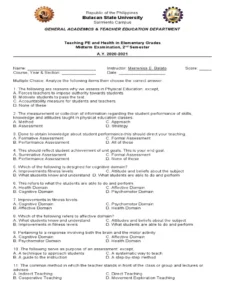
Below is the exam paper download link
Past Paper On Physical Education Subject Methods For Revision
Above is the exam paper download link
Physical Education Subject Methods is the unit that transforms a sports enthusiast into a professional educator. It teaches you how to manage fifty students in an open field, how to differentiate tasks for various physical abilities, and how to ensure every child leaves the pitch with a new skill. However, when the exam arrives, the questions go deep into the “how” and “why” of coaching.
To help you get into peak exam condition, we’ve put together a specialized Q&A session based on the themes that appear in almost every paper, followed by a link to download a full revision paper.
The Pedagogy of Motion: Key Revision Q&A
Q1: What is the “Whole-Part-Whole” method of teaching a sports skill?
A: This is a staple in PE exams.
-
Whole: You let the students try the entire skill (e.g., a full layup in basketball) to get a feel for it.
-
Part: You break the skill down and practice the difficult segments (e.g., just the footwork or just the flick of the wrist).
-
Whole: You put it all back together in a game-like situation. This method is excellent for complex skills where the “rhythm” of the movement is key.
Q2: How does a teacher ensure “Inclusion” during a high-intensity football lesson?
A: Examiners look for the STTEP principle here. You can modify:
-
Space: Make the pitch smaller or larger.
-
Task: Change the rules (e.g., everyone must touch the ball before a goal).
-
Time: Reduce the duration of sprints.
-
Equipment: Use softer or larger balls.
-
People: Change group sizes to balance skill levels.
Q3: Why is “Set Induction” different in PE compared to a geography or math class?
A: In a classroom, set induction might be a photo or a story. In PE, it is almost always a Warm-up. However, a good PE teacher uses a “Functional Warm-up” that relates to the lesson. If you are teaching javelin, your warm-up should focus on shoulder mobility and core rotation, not just jogging laps. In an exam, always link your warm-up directly to the main lesson objective.
Q4: What are the legal responsibilities of a PE teacher regarding “Duty of Care”?
A: This is a high-stakes question. You must discuss Risk Assessment. This includes checking the field for glass or holes, ensuring students wear the right gear (shin guards/mouthguards), and never leaving a class unsupervised. If a student gets injured, the examiner wants to see that you followed a clear “Emergency Action Plan.”
Why You Should Practice with This Past Paper
In a PE Methods paper, you are often asked to “Draft a 40-minute lesson plan for a track and field session.” You can’t just wing the timing. Here is why downloading the resource below is a game-changer:
-
Mastering the Breakdown: You’ll learn how to allocate time—usually 10 minutes for the warm-up, 20 minutes for the main activity, and 10 minutes for the cool-down and review.
-
Applying Theory: Can you explain how Mosston’s Spectrum of Teaching Styles (from Command style to Self-Discovery) applies to a swimming lesson? Past papers force you to bridge that gap.
-
Vocabulary Precision: Using terms like Kinesthetic Awareness, Biomechanics, and Interval Training correctly will set you apart from students who use casual “gym” talk.
Your Free Revision Resource
Ready to stop “talking a good game” and start “writing a great paper”? We have curated a comprehensive Physical Education Subject Methods Past Paper to help you refine your coaching logic and walk into the exam room with total confidence.
[Download: Physical Education Subject Methods Revision Past Paper (PDF)]
(Pro-tip: When revising, don’t just read the answers. Practice sketching a “Drill Diagram” using arrows and symbols to show player movement. A clear diagram in your exam script is worth a thousand words!)
Final Thoughts
PE is about building healthy bodies and resilient minds. By mastering these methods, you are ensuring that your future students don’t just “play,” but they “learn” through play. Download the paper, test your timing, and get ready to lead from the front.