Let’s be honest: “Philosophy and Comparative Education” sounds like a unit designed to make your head spin. One hour you are debating the metaphysical nature of truth with Socrates, and the next, you are analyzing why the Finnish vocational system outperforms the one in your home country.
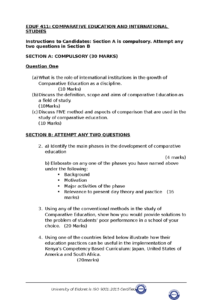
Below is the exam paper download link
Past Paper On Philosophy And Comparative Education For Revision
Above is the exam paper download link
But here is the secret: these aren’t two separate subjects. Philosophy asks, “What is the purpose of a human being?” and Comparative Education asks, “How are different countries trying to achieve that purpose?” Together, they give you the tools to see the classroom not just as a room with four walls, but as a reflection of a society’s deepest values.
To help you move past the “jargon barrier,” we’ve tackled the most frequent questions found in recent past papers to sharpen your revision.
The Revision Q&A: Cracking the Global Code
Q: What is the real difference between ‘Idealism’ and ‘Pragmatism’ in a classroom? Think of it as a battle between the “Cloud” and the “Ground.”
-
Idealism (Plato): Believes education should focus on unchanging ideas and moral truths. The teacher is a role model of wisdom.
-
Pragmatism (John Dewey): Believes education is about “what works.” It’s hands-on, focused on problem-solving and social experience. In an exam, if a question asks about the “student-centered vs. subject-centered” debate, these are the two theories you need to pit against each other.
Q: Why do we ‘Compare’ education systems anyway? Is it just for rankings? While the media loves PISA rankings (Programme for International Student Assessment), comparative education is deeper than a leaderboard. We compare to:
-
Borrowing: Finding a policy that works elsewhere and adapting it (with caution!).
-
Intellectual: Understanding how our own culture influences our teaching.
-
Global Trends: Seeing how things like Digital Literacy are moving across borders.
Q: What is the ‘Bereday Model’ of comparative analysis? George Bereday gave us the most famous four-step method for comparing systems. If you are asked to “Compare and Contrast” two countries, use this structure:
-
Description: List the data for each country.
-
Interpretation: Explain the “why” (history, religion, etc.).
-
Juxtaposition: Put the data side-by-side.
-
Comparison: Draw your final conclusions.
Q: What is ‘Existentialism’s’ main gripe with modern schooling? Existentialists like Jean-Paul Sartre believe “existence precedes essence.” In plain English: you are born first, and you define who you are later. They hate standardized testing and rigid curricula because these things try to force a “pre-made” identity onto a student. In an essay, use this to argue for more creative freedom in schools.
The Power of the Past Paper: Your Intellectual Roadmap
You can read about “Comparative Methodology” for days, but you won’t know if you’ve truly understood it until you try to analyze a case study under a 45-minute timer.
By downloading our Philosophy and Comparative Education past paper, you will:
-
Identify Question Patterns: You’ll see that questions on Colonial Education and Globalisation are becoming standard features in 2026.
-
Refine Your Vocabulary: Practice using terms like Epistemology, Educational Borrowing, and Macro-planning in context.
-
Master the Synthesis: Learn how to link a country’s economic success (Comparative) back to its cultural beliefs (Philosophy).
Download Your Revision Material Here
Ready to stop guessing and start thinking like a global strategist? Don’t leave your grades to the “shifting winds” of memory. The best way to build your confidence is to tackle the philosophical and international problems that have challenged scholars for years. Use the link below to download a curated past paper.
[Click Here to Download the Philosophy and Comparative Education Past Paper]
A Quick Parting Tip: The ‘Context’ Rule
Whenever you are writing about why a Finnish or Singaporean policy is “better,” always add a caveat about Contextualisation. You cannot just “copy and paste” a school system from one country to another. Mentioning that culture and history must match the policy is a surefire way to get that “A”!