Let’s be honest: when we talk about “development,” we often think of massive skyscrapers, high-speed rail, and paved highways. But a road is useless if no one knows how to drive, and a computer is just a box of plastic if no one can code. In the world of economics, the real engine of growth isn’t iron or oil—it’s Human Capital.
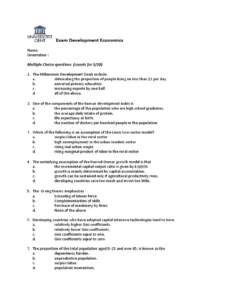
Below is the exam paper download link
Past Paper On Human Capital And Socio Economic Development For Revision
Above is the exam paper download link
The study of Human Capital and Socio-Economic Development is where the classroom meets the global market. It’s the study of how health, education, and skills transform a struggling economy into a powerhouse. If you’re preparing for an exam in this field, you need to think beyond the textbook. To help you get into the mindset of a developmental strategist, we’ve tackled the most frequent questions found in recent past papers.
The Revision Q&A: Investing in the Future
Q: What is the core difference between “Physical Capital” and “Human Capital”? Think of it like a workshop. Physical Capital is the hammer and the saw—the tools you can touch. Human Capital is the carpenter’s knowledge of how to build a house. While physical capital wears out over time (depreciation), human capital can actually grow and innovate. In your exam, if you’re asked why some countries stay poor despite having lots of natural resources, the answer is usually a lack of “Human Capital” to process those resources.
Q: How does the “Solow Growth Model” explain education? This is a favorite for examiners. The Solow model suggests that while adding more machines helps at first, you eventually hit a wall. To keep growing, you need Technological Progress, and that only comes from an educated workforce. In your revision, focus on how education shifts the production function upwards.
Q: Is “Health” actually considered part of Human Capital? Absolutely. You can’t be productive if you’re sick. Economists argue that health and education are “interdependent.” Better health means children stay in school longer and adults work more years. If a past paper asks you to design a development strategy for a low-income region, always include a Public Health component alongside schools.
Q: What is the “Brain Drain,” and why does it haunt developmental policies? This happens when a country invests in educating its people (doctors, engineers, scientists), only for them to move to wealthier countries for better pay. This is a massive “leakage” of human capital. When writing your essay, discuss how this creates a “subsidy” from poor countries to rich ones, and think of strategies like bonding or tax incentives to keep talent at home.
The Power of the Past Paper: Your Blueprint for Success
You can read about “Endogenous Growth Theory” until you’re blue in the face, but you won’t know if you’ve mastered it until you try to apply it to a real-world case study under a 45-minute timer.
By downloading our Human Capital and Development past paper, you will:
-
Master the Terminology: Practice using words like Knowledge Spillovers, Labour Productivity, and Gini Coefficient correctly.
-
Refine Your Argument: Learn how to bridge the gap between “Individual Earnings” and “National GDP.”
-
Identify Trends: You’ll notice that questions on the Sustainable Development Goals (SDGs) and Gender Equality in education are becoming increasingly common.
Download Your Revision Resource Here
Ready to turn your knowledge into a top-tier grade? Don’t leave your marks to chance. The best way to build your confidence is to tackle the global problems that have challenged students for years. Use the link below to download a curated Human Capital and Socio-Economic Development past paper.
[Click Here to Download the Human Capital and Socio-Economic Development Past Paper]
A Quick Parting Tip: The “Residual” Factor
In early economic studies, there was a portion of growth that couldn’t be explained by land or labor. They called it the “Solow Residual.” Today, we know that “residual” is mostly Human Capital. If you mention this in your exam, you’re showing the marker that you understand the history of the theory, not just the definitions!