Let’s be honest: being a subject matter expert is one thing, but knowing how to actually teach adults is an entirely different beast. In higher education, you aren’t just delivering content; you’re facilitating a transition from student to professional.
Below is the exam paper download link
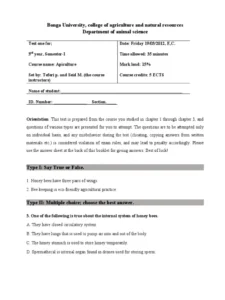
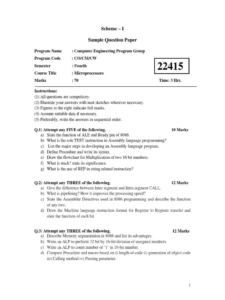
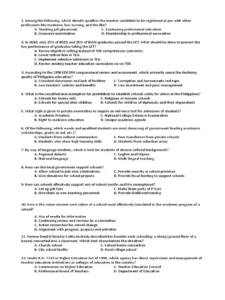
Past Paper On Teaching In Higher Education For Revision
Above is the exam paper download link
The Teaching in Higher Education module is where you move away from traditional “chalk and talk” and dive into the world of Andragogy, Action Learning, and Academic Integrity. Whether you are a budding lecturer or a teaching assistant, the shift in stakes is massive. To help you stop staring at your bibliography in a daze, we’ve tackled the big questions that frequently define the grading curve in higher ed finals.
The Revision Q&A: Navigating the Ivory Tower
Q: What is the real difference between Pedagogy and Andragogy? In your exam, this is the foundation.
-
Pedagogy is the art of teaching children—who are often dependent learners.
-
Andragogy (Malcolm Knowles) is the science of teaching adults. Adults are self-directed, they bring a wealth of life experience to the classroom, and they need to know why they are learning something before they buy in. If an exam asks you to design a seminar, always mention how you will leverage the “prior experience” of your students.
Q: How do I distinguish between ‘Formative’ and ‘Summative’ policy-page-at-mpya-news/" title="Feedback">feedback in a university setting? Think of it like cooking a soup.
-
Formative Assessment: This is the chef tasting the soup while it’s still on the stove. It’s the feedback you give during a seminar or on a draft to help the student improve.
-
Summative Assessment: This is the customer eating the soup. It’s the final grade on a thesis or an exam that determines if they pass the unit. In higher ed, there is a major push for more “Formative” moments to reduce high-stakes anxiety.
Q: Why is ‘Constructive Alignment’ the secret to a successful module? Developed by John Biggs, this is the “Golden Thread” of university teaching. It means your Learning Outcomes, your Teaching Activities, and your Assessment Tasks are all perfectly synced. If you want your students to learn “critical analysis” but your exam only asks for “definitions,” your module is out of alignment.
Q: What is the ‘Flipped Classroom’ and why is it trending? In a traditional lecture, students listen to the “Sage on the Stage.” In a Flipped Classroom, students engage with the content (videos/readings) before coming to class. The actual class time is then used for high-level discussion, debate, and problem-solving. It moves the lecturer from “Sage” to “Guide on the Side.”
The Power of the Past Paper: Your Academic Roadmap
You can read about “Bloom’s Taxonomy” or “Deep vs. Surface Learning” for hours, but you won’t know if you’ve truly understood the application until you try to critique a syllabus or design a rubric under a 45-minute timer.
By downloading our Teaching in Higher Education past paper, you will:
-
Identify Question Patterns: You’ll notice that themes like Inclusive Education and Digital Literacy are appearing in almost every modern paper.
-
Refine Your Academic Voice: Practice using terms like Reflective Practice, Threshold Concepts, and Peer Review in context.
-
Master the Rubric: Many papers ask you to “mark” a hypothetical student essay based on a provided rubric. Doing this at home is the best way to understand how markers think.
Download Your Revision Material Here
Ready to move from a researcher to a renowned educator? Don’t leave your professional development to chance. The best way to build your confidence is to tackle the pedagogical challenges that have shaped university teaching for decades. Use the link below to download a curated past paper.
[Click Here to Download the Teaching in Higher Education Past Paper]
A Quick Parting Tip: The ‘Academic Integrity’ Nuance
Whenever you are asked about assessment design, always mention Authentic Assessment. This means designing tasks that mimic real-world professional work (like writing a policy brief or a lab report) rather than just a standard essay. Not only is it better for learning, but it also makes it much harder for students to use AI or “contract cheating” to pass!
Back to Mpya News Home page: Education, Fashion, Law, business and sports

Last updated on: February 4, 2026
New information gained / new value takehome
- Let’s be honest: being a subject matter expert is one thing, but knowing how to actually teach adults is an entirely different beast.
- In higher education, you aren’t just delivering content; you’re facilitating a transition from student to professional.
- Below is the exam paper download link Past Paper On Teaching In Higher Education For Revision Above is the exam paper download linkRelated Read: Download Strength Of Materials Exam Past Paper The Teaching in Higher Education module is where you move away from traditional “chalk and talk” and dive into the world of Andragogy, Action Learning, and Academic Integrity.
- Whether you are a budding lecturer or a teaching assistant, the shift in stakes is massive.
- To help you stop staring at your bibliography in a daze, we’ve tackled the big questions that frequently define the grading curve in higher ed finals.
This content was developed using AI as part of our research process. To ensure absolute accuracy, all information has been rigorously fact-checked and validated by our human editor, Collins Murithi.
