Let’s be real for a second—Home Science is often misunderstood as just “cooking and sewing.” But if you’re enrolled in this course, you know it’s a rigorous blend of science, economics, and sociology. From understanding the chemical reaction of leavening agents to the complexities of consumer education, there is a lot of ground to cover.
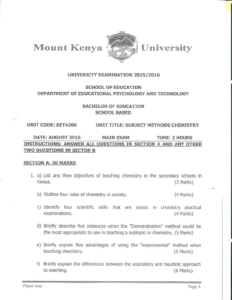
Below is the exam paper download link
past paper on Introduction To Home Science For Revision
Above is the exam paper download link
The secret to not just passing, but excelling, lies in one specific strategy: Active Recall via Past Papers. To help you get started, we’ve tackled some of the “heavy-hitter” questions often found in introductory papers, followed by a direct download link for your revision.
Key Revision Questions & Expert Answers
Q1: Home Science is described as both an “Art” and a “Science.” How so?
A: This is a classic “icebreaker” question in most exams. It is a science because it involves systematic study—think of nutrition (biochemistry), textile science (physics and chemistry), and hygiene (microbiology). It is an art because it requires creative application, such as interior design, meal presentation, and the aesthetic craft of dressmaking.
Q2: What are the three main pillars of “Good Grooming” mentioned in the syllabus?
A: Examiners look for these specific points:
-
Personal Hygiene: Regular cleaning of the body, hair, and teeth.
-
Posture: The way you carry yourself, which affects both health and confidence.
-
Clothing: Wearing clothes that are clean, well-pressed, and appropriate for the occasion.
Q3: Explain the role of “Consumer Education” in Home Science.
A: This isn’t just about shopping; it’s about survival in a modern economy. Consumer education teaches students how to interpret labels, understand their rights when they buy faulty goods, and—most importantly—how to budget. If a question asks about the “wise consumer,” always mention budgeting and comparative shopping.
Q4: Why is “First Aid” a compulsory topic in the introductory module?
A: Because the home and the lab are the most common places for accidents like burns, scalds, and cuts. A Home Science student must be a first responder. Knowing the difference between a burn (dry heat) and a scald (moist heat) is a common exam trick—make sure you have that distinction memorized!
Why You Need to Download This Past Paper
Reading your notes is passive. Answering a past paper is active. When you download the paper provided below, don’t just read through it—simulate the exam environment.
-
-
Spot the “Booby Traps”: Examiners love to ask about the “Classification of Nutrients” or “Methods of Cooking.” By doing the past paper, you’ll see exactly how they word these questions to trip you up.
-
Practice the Diagrams: Home Science papers often require you to sketch. Whether it’s the structure of a tooth or a cross-section of a garment seam, practicing these on paper is the only way to get them right under pressure.
-
Check Your Speed: You usually have about 2 to 2.5 hours. If you spend 40 minutes on the “Importance of Home Science” question, you’re in trouble. Use our download to time yourself.
-

Ready to Ace Your Exams? Download Here!
We’ve sourced a comprehensive, high-standard past paper that covers the breadth of the Introduction to Home Science curriculum. Click the link below to save it to your device.
[Download: Introduction to Home Science Revision Past Paper (PDF)]
(Note: This file includes both the question paper and a suggested marking guide to help you self-evaluate.)

Final Thoughts
Success in Home Science is about being practical. You’ve done the practicals in the lab; now it’s time to do the “practical” work on your desk. Use this paper, identify your weak spots, and go back to your textbooks for those specific areas. You’ve got this!
Back to Mpya News Home page: Education, Fashion, Law, business and sports
Last updated on: January 26, 2026
New information gained / new value takehome
- Key Revision Questions & Expert Answers Q1: Home Science is described as both an “Art” and a “Science.
- It is a science because it involves systematic study—think of nutrition (biochemistry), textile science (physics and chemistry), and hygiene (microbiology).
- It is an art because it requires creative application, such as interior design, meal presentation, and the aesthetic craft of dressmaking.
- Consumer education teaches students how to interpret labels, understand their rights when they buy faulty goods, and—most importantly—how to budget.
- A: Because the home and the lab are the most common places for accidents like burns, scalds, and cuts.
- Why You Need to Download This Past Paper Reading your notes is passive.
- [Download: Introduction to Home Science Revision Past Paper (PDF)] (Note: This file includes both the question paper and a suggested marking guide to help you self-evaluate.
- Back to Mpya News Home page: Education, Fashion, Law, business and sports Last updated on: January 26, 2026Mpya News Sitemap .
- News Education Rankings Reference 2: SNHU Distance Learning Reference 3: GCU University Programs Photo credit: instagram.
This content was developed using AI as part of our research process. To ensure absolute accuracy, all information has been rigorously fact-checked and validated by our human editor, Collins Murithi.