If you’ve ever felt like your Immunology lectures are just an endless alphabet soup of CD markers, interleukins, and MHC haplotypes, you aren’t alone. Immunology is uniquely difficult because it isn’t linear; it’s a massive, synchronized dance occurring at the molecular level. You can’t just memorize a list of parts; you have to understand how those parts communicate in real-time to defend against a literal world of pathogens.
Below is the exam paper download link
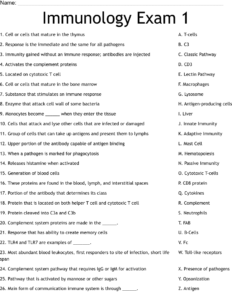
past paper On Fundamentals Of Immunology For Revision
Above is the exam paper download link
Most students fail not because they didn’t study, but because they couldn’t apply the theory to a clinical or experimental scenario. This is where active testing comes in. Using a past paper forces you to stop being a passive reader and starts training your brain to recognize the “signals” in a question.
To help you move from confusion to clarity, we’ve provided a high-quality revision resource below.
To get your gears turning, let’s break down four of the most frequent “killer” questions found in introductory Immunology exams.


Q1: What is the fundamental difference between “Innate” and “Adaptive” immunity?
This is the cornerstone of the entire field. If you don’t have this distinction down, the rest of the course will feel like a blur.
The Answer: Think of the Innate system as your first responders. It’s non-specific, meaning it recognizes general patterns (PAMPs) found on many microbes. It acts within minutes to hours and, crucially, it has no memory—it treats every encounter like the first one.
The Adaptive system is your “Special Forces.” It is highly specific to a single epitope. It takes days to ramp up during the first exposure, but it creates memory cells. The next time that specific pathogen shows up, the response is so fast and fierce you likely won’t even feel symptoms.
Q2: Explain the concept of MHC Restriction. Why does it matter?
This is often where students get tripped up. Why can’t a T-cell just “see” a virus floating in the blood?
The Answer: T-cells are “blind” to free-floating antigens. They can only recognize an antigen if it is “presented” to them on a silver platter—that platter is the Major Histocompatibility Complex (MHC) molecule.
-
MHC Class I: Found on almost all nucleated cells. It presents internal cellular “trash” to CD8+ Cytotoxic T-cells. If the cell is infected, the T-cell kills it.
-
MHC Class II: Found only on professional Antigen-Presenting Cells (APCs) like dendritic cells. It presents “captured” external invaders to CD4+ Helper T-cells to coordinate a wider immune response.
Q3: How does the body generate millions of different antibodies from only a few genes?
If we had one gene for every antibody, our genome would be too big to fit in a cell. So, how does the math work?


The Answer: The secret is Somatic Recombination (or V(D)J recombination). Instead of having one static gene, the body has “libraries” of gene segments (Variable, policy-for-editorial-content-mpya-news/" title="Diversity">Diversity, and Joining). As a B-cell matures, it physically cuts and pastes one segment from each library together in a random combination. When you add in “junctional diversity” (the messy, imprecise way these segments are joined), the mathematical possibilities become virtually infinite.
Q4: Describe the five classes of Immunoglobulins and their primary roles.
You don’t need to know every detail, but you must know the “personality” of each antibody type.
The Answer:
-
IgM: The first responder. It’s a pentamer (five units), making it great at “clumping” pathogens together.
-
IgG: The most abundant in the blood and the only one that can cross the placenta to protect a fetus.
-
IgA: Found in secretions (tears, saliva, breast milk). It’s your mucosal shield.
-
IgE: The “allergy” antibody. It binds to mast cells and triggers histamine release; it’s also your main weapon against parasites.
-
IgD: Primarily acts as a receptor on the surface of B-cells.


Strategy for Using Your Past Paper
-
Simulate the Stress: Don’t do the paper with your textbook open. Give yourself a quiet room and a timer.
-
The “Why” Method: For every multiple-choice question, don’t just find the right answer. Explain to yourself why the other three options are wrong.
-
Draw the Synapse: When studying T-cell activation, draw the “immunological synapse” (the TCR, MHC, and co-stimulatory molecules). If you can draw it, you know it.
Back to Mpya News Home page: Education, Fashion, Law, business and sports
Last updated on: February 28, 2026
New information gained / new value takehome
- If you’ve ever felt like your Immunology lectures are just an endless alphabet soup of CD markers, interleukins, and MHC haplotypes, you aren’t alone.
- Immunology is uniquely difficult because it isn’t linear; it’s a massive, synchronized dance occurring at the molecular level.
- You can’t just memorize a list of parts; you have to understand how those parts communicate in real-time to defend against a literal world of pathogens.
- Below is the exam paper download link past paper On Fundamentals Of Immunology For Revision Above is the exam paper download linkRelated Read: Download PDF Past Paper On Assembly and Maintenance past paper For Revision Most students fail not because they didn’t study, but because they couldn’t apply the theory to a clinical or experimental scenario.
- This is where active testing comes in.
This content was developed using AI as part of our research process. To ensure absolute accuracy, all information has been rigorously fact-checked and validated by our human editor, Collins Murithi.
External resource 1: Google Scholar Academic Papers
External resource 2: Khan Academy Test Prep
Reference 1: KNEC National Examinations
Reference 2: JSTOR Academic Archive
Reference 3: Shulefiti Revision Materials
Photo credit: instagram.com