Let’s be honest: in the world of healthcare, the “what” (pills, surgery, biology) is often easier to memorize than the “why” (culture, poverty, social stigma). Medical Sociology and Anthropology is the field that reminds us that a patient isn’t just a collection of symptoms, but a human being moving through a complex social world.
Below is the exam paper download link
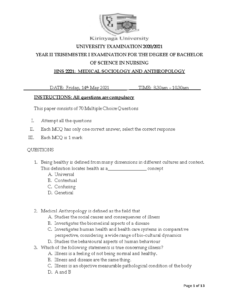
Past Paper On Medical Sociology And Anthropology For Revision
Above is the exam paper download link
When the exam draws near, the challenge isn’t just knowing definitions; it’s about understanding how a person’s zip code can be more important to their health than their genetic code. To help you navigate the bridge between the clinic and the community, we’ve tackled the big “essay-trigger” questions found in recent past papers.
The Revision Q&A: Cracking the Cultural & Social Code
Q: What is Talcott Parsons’ ‘Sick Role’ and is it still relevant? This is a staple in Medical Sociology. Parsons argued that being sick isn’t just a biological state; it’s a social role with rights and obligations.
-
The Rights: You are exempt from normal social roles (work/school) and aren’t blamed for your condition.
-
The Obligations: You must try to get well and seek technically competent help. In an exam, markers love it when you critique this—does the “Sick Role” apply to chronic illnesses like diabetes? Probably not as neatly as Parsons thought.

Q: How do ‘Social Determinants of Health’ (SDOH) explain health inequalities? If you see a question about why certain populations have higher mortality rates, the answer lies in the SDOH. These are the conditions in which people are born, grow, live, and work.
-
Key Factors: Income, education, physical environment, and social support networks. When writing your answer, remember: Medicine can fix the body, but Sociology explains why the body got sick in the first place.
Q: What is the ‘Medicalization of Society’? This is the process by which non-medical problems (like sadness, hyperactivity, or even aging) become defined and treated as medical disorders. Think about how we view “burnout” today versus fifty years ago. In your revision, look for questions asking about the power of pharmaceutical companies or the expanding “jurisdiction” of doctors.
Q: How does Medical Anthropology distinguish between ‘Illness’ and ‘Disease’? This is a “must-know” for the Anthropology section.
-
Disease: The biological malfunction or “doctor’s perspective” (e.g., a viral infection).
-
Illness: The patient’s experience of being unwell, shaped by their culture and personal story. If an exam asks about “Cultural Competency,” your answer should focus on how healers must address the illness to successfully treat the disease.
The Power of the Past Paper: Your Cultural Roadmap
You can read about “Ethnomedicine” until you’re blue in the face, but Medical Sociology is a subject that rewards critical analysis. You need to know how to link a theory like Symbolic Interactionism to the way a patient interacts with their nurse under a 45-minute timer.
By downloading our Medical Sociology and Anthropology past paper, you will:
-
Master the Theory: Practice applying Functionalism or Marxist Perspectives to healthcare systems.
-
Refine Your Logic: Learn how to argue for the “Biopsychosocial Model” over the traditional “Biomedical Model.”
-
Spot the Trends: You’ll notice that questions on Global Health Pandemics and Digital Health Disparities are huge in 2026.

Download Your Revision Material Here
Ready to turn your social insights into a distinction? Don’t leave your grades to “common sense.” The best way to build your confidence is to tackle the structural and cultural puzzles that have challenged social scientists for years. Use the link below to download a curated past paper.
[Click Here to Download the Medical Sociology and Anthropology Past Paper PDF]

A Quick Parting Tip: The ‘Inverse Care Law’
Whenever you’re writing about health inequality, mention the Inverse Care Law. It states that the availability of good medical care tends to vary inversely with the need for it in the population served. In simple terms: those who need the most help often get the least. Dropping this concept into an essay is a surefire way to impress your marker!
Back to Mpya News Home page: Education, Fashion, Law, business and sports

Last updated on: February 6, 2026
New information gained / new value takehome
- Key Factors: Income, education, physical environment, and social support networks.
- Back to Mpya News Home page: Education, Fashion, Law, business and sports Last updated on: February 6, 2026Mpya News Sitemap .
- News Education Rankings Reference 2: SNHU Distance Learning Reference 3: GCU University Programs Photo credit: instagram.
This content was developed using AI as part of our research process. To ensure absolute accuracy, all information has been rigorously fact-checked and validated by our human editor, Collins Murithi.