Let’s be honest: many students walk into Geography thinking it’s all about naming capital cities and identifying rock types. Then, they hit The History of Geographic Thought and realize they’ve actually signed up for a philosophy degree with a compass.
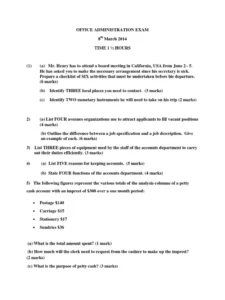
Below is the exam paper download link
Past Paper On History Of Geographic Thought For Revision
Above is the exam paper download link
This unit isn’t about where things are; it’s about how we decided to look at them. It’s the story of how a discipline moved from the explorers of Ancient Greece to the satellite data of 2026. If you are struggling to tell your Positivism from your Post-modernism, you aren’t alone. To help you navigate this intellectual terrain, we’ve tackled the big “essay-killers” found in recent past papers.
The Revision Q&A: Cracking the Geographical Code
Q: What is ‘Environmental Determinism’ and why did it fall out of favor? This was the “hot take” of the early 20th century, championed by thinkers like Ellen Churchill Semple and Friedrich Ratzel. It argued that the physical environment (climate, topography) strictly determines human culture and social development.
The Critique: Critics like Carl Sauer pointed out that this view was overly simplistic and often used to justify colonial prejudices. It was replaced by Possibilism, which suggests that while the environment sets limits, humans have the agency to choose how to respond.
Q: How did the ‘Quantitative Revolution’ change Geography in the 1950s? Before the 1950s, geography was mostly descriptive—like a travel log. The Quantitative Revolution tried to make geography a “hard science.” Geographers started using math, statistics, and spatial modeling to find universal laws.


-
The Goal: To move from the “unique” (idiographic) to the “general” (nomothetic). If you see a question about the origins of GIS (Geographic Information Systems), this revolution is where it all started.
Q: What is ‘Hartzhorne’s Areal Differentiation’? Richard Hartshorne argued that the core of geography is “Chorology”—the study of the unique character of regions. He believed geographers should focus on how different factors (climate, religion, economy) come together to make one place different from another. In an exam, contrast this with Spatial Science, which looks for patterns that apply everywhere.
Q: What is the ‘Cultural Turn’ in Geographic Thought? Starting in the 1970s and 80s, geographers got bored with just numbers and started looking at Humanistic Geography. This focuses on “Place” vs. “Space.”
-
Space: A coordinate on a map (abstract).
-
Place: A location filled with human meaning, memory, and emotion (subjective). Yi-Fu Tuan’s concept of “Topophilia” (love of place) is a brilliant term to drop into an answer about human-environment interaction.
The Power of the Past Paper: Your Intellectual Compass
You can read about Alexander von Humboldt until you’re blue in the face, but the History of Geographic Thought requires you to argue. You need to know how to compare the Berkeley School of Landscape with Marxist Geography under a 45-minute timer.
By downloading our History of Geographic Thought past paper, you will:
-
Master the Paradigms: Practice identifying which “ism” (Structuralism, Feminism, Positivism) a specific geographic approach belongs to.
-
Refine Your Argument: Learn how to critique the “Objectivity” of early maps.
-
Spot the Trends: You’ll notice that questions on Decolonizing Geography and Anthropocene policy-page-at-mpya-news/" title="Ethics">Ethics are huge in 2026.

Download Your Revision Material Here
Ready to turn your theoretical confusion into a distinction? Don’t leave your grades to “mental drift.” The best way to build your confidence is to tackle the philosophical puzzles that have shaped our world view for centuries. Use the link below to download a curated past paper.
[Click Here to Download the History of Geographic Thought Past Paper PDF]

A Quick Parting Tip: The ‘Paradigm Shift’ Rule
Whenever you are writing about a major change in the subject, use Thomas Kuhn’s term “Paradigm Shift.” It describes those moments (like the shift from descriptive to quantitative) when the whole “rulebook” of a science is rewritten. Using this term shows the marker you aren’t just a geography student—you’re a scholar of science.
Back to Mpya News Home page: Education, Fashion, Law, business and sports
Last updated on: February 7, 2026
New information gained / new value takehome
- The Goal: To move from the “unique” (idiographic) to the “general” (nomothetic).
- Richard Hartshorne argued that the core of geography is “Chorology”—the study of the unique character of regions.
- Back to Mpya News Home page: Education, Fashion, Law, business and sports Last updated on: February 7, 2026Mpya News Sitemap .
- News Education Rankings Reference 2: SNHU Distance Learning Reference 3: GCU University Programs Photo credit: instagram.
This content was developed using AI as part of our research process. To ensure absolute accuracy, all information has been rigorously fact-checked and validated by our human editor, Collins Murithi.

