West African literature is a vibrant tapestry woven from ancient oral traditions, colonial friction, and the bold voices of independence. From the bustling streets of Lagos in Ekwensi’s novels to the haunting spirits in Ben Okri’s prose, this region has produced some of the most influential writing in the world.
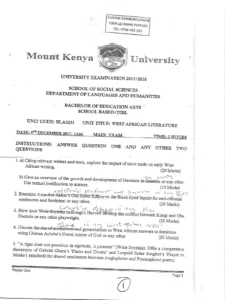
Below is the exam paper download link
Past Paper On West African Literature For Revision
Above is the exam paper download link
But let’s be honest: when you’re facing an exam that covers everything from Things Fall Apart to the complex plays of Wole Soyinka, it’s easy to feel like you’re lost in a thicket of metaphors. The secret to a top grade isn’t just knowing “what happened”; it’s understanding the cultural and political pulse behind the words. To help you sharpen your critical eye, we’ve tackled the big questions that define West African literature exams.
The Revision Q&A: Cracking the Canon
Q: Why does ‘Culture Conflict’ dominate so many West African novels? This is the “bread and butter” of West African literature. Examiners love to see if you can analyze the friction between traditional African values and the encroaching Western influence. Think of Okonkwo’s struggle in Achebe’s work—it’s not just a personal tragedy; it’s a symbolic one. When answering, use terms like “The Clash of Civilizations” or “Cultural Dislocation” to describe how characters feel caught between two worlds.
Q: How do I handle ‘Proverbs’ in an essay analysis? In West African literature, proverbs are not just “flavor”; they are the “palm oil with which words are eaten.” If an exam question asks about style, focus on how proverbs lend authority and philosophical depth to characters. Mention that this is a technique of “indigenizing” the English language—taking a colonial tool and making it sound authentically African.
Q: What is the significance of ‘The Onitsha Market Literature’? Often appearing in history-of-literature questions, this was the “pop culture” of the 1940s and 50s. It consists of cheaply printed pamphlets, plays, and advice books sold in Nigeria. It’s important because it represents the democratization of reading and writing. Mentioning it shows the examiner you know that literature didn’t just happen in universities; it happened in the marketplaces too.
Q: How do I approach the ‘Political Satire’ of writers like Wole Soyinka or Ayi Kwei Armah? Post-independence literature shifted from fighting the colonizer to criticizing the new African leadership. If you’re analyzing Armah’s The Beautyful Ones Are Not Yet Born, focus on the theme of “Post-Colonial Disillusionment.” Use the imagery of filth and decay found in the text to explain how the author feels about corruption.
The Power of the Past Paper: Your Exam Strategy
Reading a masterpiece is one thing; dissecting it under a 60-minute clock is quite another. West African literature papers often ask you to “Compare and Contrast” or “Critically Evaluate”—tasks that require a clear structure.
By downloading our West African Literature past paper, you will:
-
Master Character Archetypes: Learn to identify the “Tragic Hero,” the “Alienated Intellectual,” and the “Earth Mother” across different texts.
-
Practice Contextualization: See how to link a poem’s themes to specific historical events like the Nigerian Civil War (Biafra).
-
Perfect Your Stylistic Analysis: Practice spotting “Animist Realism”—where the spirit world and the physical world coexist seamlessly, a hallmark of many West African writers.
Download Your Revision Resource
Ready to stop skimming and start analyzing? Don’t let the depth of the “African Giant” intimidate you. The best way to build your confidence is to tackle the questions that have stumped students in previous years. Use the link below to download a full West African Literature past paper and start your journey toward that “A.”
[Click Here to Download the West African Literature Past Paper for Revision]
A Quick Parting Tip: The ‘Orality’ Factor
Whenever you are writing about a West African novel, look for Orality. Is there a character who tells stories? Is there a call-and-response pattern in the dialogue? Is there a heavy use of repetition? Pointing out these “oral remnants” in a written text proves to the marker that you understand the unique DNA of West African writing.