If you’ve ever wondered why some religions thrive in modern cities while others fade, or how a small “cult” transforms into a global “denomination,” you’re already thinking like a sociologist. The Sociology of Religion isn’t about the truth of spiritual claims; it’s about how those claims shape—and are shaped by—human behavior, power structures, and social change.
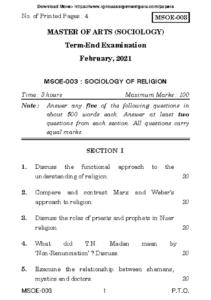
Below is the exam paper download link
Past Paper On Sociology Of Religion For Revision
Above is the exam paper download link
However, moving from casual observation to academic mastery is a challenge. Sociology exams require you to juggle heavy-hitting theories from names like Weber, Durkheim, and Marx while applying them to modern-day issues like fundamentalism and the digital church. The best way to sharpen your “sociological imagination” is to work through past papers.
To help you get started, we’ve broken down some recurring exam themes in a Q&A format, followed by a link to download a full revision paper.
Sociology of Religion: The Revision Q&A
Q1: How did Émile Durkheim define religion, and why does he focus on the “Sacred” and the “Profane”?
A: Durkheim viewed religion as a “social glue.” For him, religion is a unified system of beliefs and practices relative to sacred things—things set apart and forbidden. The profane, on the other hand, is the mundane, everyday world. In an exam, emphasize that Durkheim believed that when people worship a deity, they are actually worshipping the power of society itself.
Q2: What did Max Weber mean by the “Disenchantment of the World”?
A: Weber argued that as Western society became more rationalized and bureaucratic, the “magical” and supernatural explanations for life were replaced by scientific ones. This process, known as Entzauberung, is a key part of his theory on Secularization. If you see a question on the “Protestant Ethic,” remember to connect it to how religious values actually gave birth to modern Capitalism.
Q3: What is the difference between a ‘Sect’ and a ‘Cult’ in sociological terms?
A: This is a popular comparison question.
-
Sects are usually offshoots of established religions (like the Amish). They are often “exclusive” and claim to have the monopoly on truth.
-
Cults (or New Religious Movements) are often innovative and loosely organized. They don’t necessarily break away from a church but offer a completely new spiritual path. In an exam, avoid using “cult” as a slur; treat it as a technical category of organization.
Q4: Is the world really becoming more secular?
A: This is the “Secularization Debate.” Some sociologists argue that religious influence is declining (the Secularization Thesis). Others point to the rise of Post-Secularism and “Believing without Belonging,” where people still have faith but don’t attend traditional church services. A high-scoring answer will always present both sides of this argument.
Why You Should Practice with This Past Paper
In a Sociology exam, the “how” is just as important as the “what.” Here is why downloading the resource below is vital:
-
Evaluating the “Big Three”: Most papers will ask you to compare functionalist (Durkheim), conflict (Marx), and interactionist (Weber) perspectives. Practicing allows you to map out these arguments quickly.
-
Structuring Essays: Sociology requires a specific essay structure: Introduction, Theory, Evidence/Case Study, Criticism, and Conclusion. Past papers help you get this rhythm into your muscle memory.
-
Applying Contemporary Examples: Modern papers often ask about religion and the media or religion and globalization. Using a past paper helps you see how to weave current events into classical theory.
Download Your Revision Material
Don’t go into your exam room with just “thoughts and prayers”—go in with a plan. We have curated a comprehensive Sociology of Religion Past Paper to help you test your knowledge and timing.
[Download: Sociology of Religion Revision Past Paper (PDF)]
(Pro-tip: When answering, try to use “Internal Critiques.” For example, if you describe Marx’s view of religion as the “opium of the people,” follow it up by mentioning how religion can also be a force for social liberation, like in Civil Rights movements.)
Final Thoughts
Sociology of Religion is a fascinating lens through which to view the world. By mastering these past papers, you aren’t just memorizing definitions; you are learning to analyze the very structures that hold our societies together.