Let’s be honest: Research Methods is often the “black sheep” of any degree program. It doesn’t have the flashy stories of history or the philosophical debates of sociology. Instead, it’s about the “how”—the cold, clinical, and precise way we discover the truth.
Below is the exam paper download link
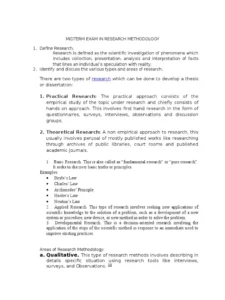
Past Paper On Research Methods For Revision
Above is the exam paper download link
But here’s the secret: Research Methods is the most powerful tool in your academic arsenal. It is the difference between having an opinion and having evidence. Whether you are terrified of “standard deviation” or confused by “phenomenology,” the best way to conquer this subject is to see how the theories are applied in real exam scenarios. To help you move from confusion to clarity, we’ve tackled the big “must-know” questions from recent past papers.
The Revision Q&A: Thinking Like a Researcher
Q: How do I choose between Quantitative and Qualitative methods? This is the most common starting point. Think of it as a choice between breadth and depth.
-
Quantitative: You want numbers, trends, and generalizations. You use surveys and experiments to answer “How many?” or “How much?”
-
Qualitative: You want meaning, experience, and context. You use interviews and focus groups to answer “Why?” or “How?” In your exam, if the scenario involves a large population, go Quantitative. If it involves deep human emotion or culture, go Qualitative.
Q: What is the difference between ‘Reliability’ and ‘Validity’? This is a classic “trap” question.
-
Reliability is about consistency. If you repeat the research, do you get the same result? (Like a scale that always shows the same weight).
-
Validity is about accuracy. Are you actually measuring what you claim to measure? (Like a scale that shows your true weight, not just a consistent wrong number). A study can be reliable but not valid, but it can never be valid if it isn’t first reliable.
Q: Why is ‘Sampling Strategy’ so critical to my answer? Because you can’t study everyone. Your results are only as good as the people you choose to talk to. Examiners look for keywords like Random Sampling (to avoid bias) and Snowball Sampling (used for hard-to-reach groups). If a past paper asks you to critique a study, always look at the sample size and the selection method—it’s usually where the biggest flaws hide.
Q: What are ‘Research Ethics,’ and why are they a high-point topic? In 2026, ethics are more important than ever. You must mention Informed Consent, Anonymity, and the Right to Withdraw. If you are asked to design a study involving vulnerable groups (like children), your first paragraph should be about how you will protect them from harm.
The Power of the Past Paper: Your Strategy for Success
You can read about “Ontology” and “Epistemology” until your head spins, but Research Methods is a practical skill. You need to know how to spot a “leading question” in a survey or how to code a transcript under a 45-minute timer.
By downloading our Research Methods past paper, you will:
-
Master the Jargon: Practice using terms like Triangulation, Null Hypothesis, and Likert Scale correctly.
-
Refine Your Logic: Learn how to justify your choice of methodology—this is where the “A” students separate themselves from the rest.
-
Identify Trends: You’ll notice that questions on Mixed Methods and Digital Ethnography are becoming standard in modern papers.
Download Your Revision Material Here
Ready to turn your research dread into a distinction? Don’t leave your performance to the “margin of error.” The best way to build your confidence is to tackle the methodological puzzles that have challenged students for years. Use the link below to download a curated Research Methods past paper.
[Click Here to Download the Research Methods Past Paper for Revision]

A Quick Parting Tip: The ‘Triangulation’ Rule
Whenever you are asked how to make a study “stronger,” the answer is almost always Triangulation. This simply means using more than one method or data source to double-check your findings (e.g., using both a survey and an interview). Mentioning this shows the examiner that you understand how to build a rigorous, bulletproof study!