Let’s be honest—for many students, the word “Quantitative” is just a fancy way of saying “Math that makes my head spin.” Whether you are studying Business, Social Sciences, or Education, Quantitative Skills I is that foundational unit that everyone has to pass, but few truly enjoy studying.
Below is the exam paper download link
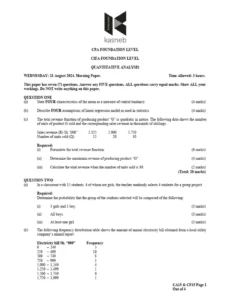
Past Paper on Quantitative Skills I for Revision
Above is the exam paper download link
The biggest mistake students make is trying to “read” math like a novel. You can’t memorize a formula and expect to win; you have to see how that formula behaves when an examiner throws a curveball at you. That is exactly why practicing with past papers is non-negotiable.
To get your brain in gear, we’ve broken down some of the most common exam questions you’ll encounter.
Quantitative Skills I: The Revision Q&A
Q1: What is the difference between Discrete and Continuous data?
A: This is a “Section A” favorite.
-
Discrete Data consists of distinct, separate values. You can count them. Example: The number of students in a classroom (you can’t have 20.5 students).
-
Continuous Data can take any value within a range. You measure it. Example: The height of those students or the time it takes to finish an exam.
Q2: When should I use the Mean versus the Median?
A: This is about understanding “outliers.” Use the Mean (average) for normal data sets without extreme values. However, if you have one or two numbers that are way higher or lower than the rest (like comparing the salaries of ten janitors and one billionaire), the Median (middle value) gives a much fairer picture of the “center.”
Q3: What is the significance of the “Standard Deviation”?
A: In simple terms, Standard Deviation tells you how “spread out” your data is. A low standard deviation means most of the numbers are very close to the average. A high one means the data is scattered all over the place. In an exam, if you’re asked to “Comment on the consistency” of two sets of data, look at the Standard Deviation—the lower one is always more consistent.
Q4: How do I tackle basic Probability questions?
A: Always start with the formula:
Whether it’s drawing a card from a deck or picking a marble from a bag, identify your “Total” first. If the question says “without replacement,” remember to subtract one from your total for the second event!
The Power of Practice: Why Download This Paper?
Math is a “doing” subject. When you download the past paper linked below, you aren’t just looking at questions; you are training your “pattern recognition” muscles.
-
Spotting the Formula: Most papers provide a formula sheet, but if you don’t know which formula for “Simple Interest” vs. “Compound Interest” to use, the sheet won’t save you.
-
Structuring Your Working: Examiners give partial marks! Even if your final answer is wrong, showing your steps clearly can be the difference between a D and a B.
-
Beating the Clock: Quantitative exams are notorious for being long. By practicing with this paper, you’ll learn which questions to tackle first (usually the easy marks in Section A) and which ones to save for last.
Your Free Revision Resource
Ready to stop worrying and start solving? We have curated a high-quality past paper that mirrors the standard of most university and college “Quantitative Skills I” modules.
[Download: Quantitative Skills I Revision Past Paper (PDF)]
(Pro-tip: Don’t check the marking scheme until you’ve spent at least 90 minutes trying to solve the problems yourself. The struggle is where the actual learning happens!)
Final Thoughts
Quantitative Skills isn’t about being a “math genius”; it’s about being a disciplined practitioner. Use this paper to identify where you’re getting stuck—is it the Venn Diagrams? The Linear Equations? The Measures of Central Tendency? Once you know your weakness, you can attack it.