Studying Modern Islamic Reform Movements is like watching a grand intellectual debate unfold over the last two centuries. It’s the story of how Islamic thinkers responded to the pressure of Western colonialism, the rise of modern science, and the shifting tides of political power. From the salons of Paris to the lecture halls of Al-Azhar, these movements sought to answer one question: How can Islam remain authentic while embracing the modern world?
Below is the exam paper download link
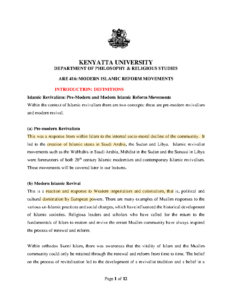
Past Paper On Modern Islamic Reform Movement For Revision
Above is the exam paper download link
Whether you are analyzing the “Salafiyya” of the 19th century or the “Islamization of Knowledge” in the 20th, the syllabus is dense with philosophy and political theory. To move from being a student who just “knows names” to one who “understands arguments,” you need to practice with past papers.
To help you sharpen your perspective, we’ve put together a specialized Q&A session based on recurring exam themes, followed by a link to download a full revision paper.
The Reformer’s Toolkit: Revision Q&A
Q1: What was the primary goal of the “Nahda” (Arab Awakening) thinkers like Jamal al-Din al-Afghani?
A: This is a foundation question. Al-Afghani and his peers weren’t just religious leaders; they were political activists. Their goal was Pan-Islamism—the idea that the Muslim world needed to unite against Western imperialism. They argued that Islam was inherently rational and scientific, and that Muslims had fallen behind only because they had abandoned the true, intellectual spirit of the faith.
Q2: How did Muhammad Abduh’s approach to “Ijtihad” change modern Islamic education?
A: Abduh is the “father of Islamic Modernism.” He famously called for the reopening of Ijtihad (independent legal reasoning), arguing that the doors of interpretation were never meant to be closed. In an exam, emphasize that Abduh wanted to reconcile reason (Aql) with revelation (Naql). He believed that true Islam could never contradict science, leading to major reforms at Al-Azhar University.
Q3: What distinguishes the “Puritanical” reform of Muhammad ibn Abd al-Wahhab from the “Modernist” reform?
A: This is a classic comparison prompt.
-
Wahhabism sought to return to the “pure” practices of the Salaf (the first three generations of Muslims) by stripping away what they saw as local cultural “innovations” (Bida).
-
Modernists, like Sir Sayyid Ahmad Khan in India, sought to interpret Islamic principles in light of modern progress and Western education. One looks back to preserve; the other looks forward to adapt.
Q4: What is the significance of the Muslim Brotherhood (Ikhwan al-Muslimun) in the context of 20th-century reform?
A: Founded by Hasan al-Banna, the Brotherhood shifted the focus from purely intellectual debate to grassroots social and political activism. They argued that Islam is a “complete system” (Nizam Kamil) covering politics, economics, and social life. If a question asks about “Political Islam” or “Islamism,” this is your starting point.
Why You Should Practice with This Past Paper
In an exam on Modern Reform, the examiner isn’t just looking for a history lesson; they are looking for critical analysis. Here is why downloading the resource below is vital:
-
Connecting Theory to Context: Most papers ask you to explain why a movement started in a specific place (like the Sokoto Caliphate in West Africa vs. the Aligarh Movement in India). Past papers help you link the “Idea” to the “Location.”
-
Mastering the Terminology: Do you know the difference between Tajdid (Renewal) and Islah (Reform)? Using these terms accurately will immediately boost your marks.
-
Perfecting the “Evaluate” Essay: Many questions start with “Critically evaluate the success of…” These require you to look at both the achievements and the failures of a movement. Practicing this balance is key.
Download Your Revision Material
Ready to master the complexities of modern Islamic thought? We have curated a high-standard Modern Islamic Reform Movements Past Paper to help you test your timing and your arguments.
[Download: Modern Islamic Reform Movements Past Paper (PDF)]
(Pro-tip: When revising, try to group your notes by ‘Theme’—e.g., Education, Women’s Rights, and Political Independence. This makes it much easier to pull information for those broad, 20-mark essay questions!)
Final Thoughts
The modern history of Islam is a vibrant tapestry of debate and resilience. By mastering these past papers, you are doing more than preparing for an exam; you are gaining insight into the ideas that continue to shape our world today. Download the paper, grab your coffee, and start your revision journey.