Let’s be real for a second: being a “math person” and being a “math teacher” are two completely different ballgames. You might be able to solve a quadratic equation in your sleep, but can you explain why it works to a classroom of thirty teenagers who would rather be anywhere else?
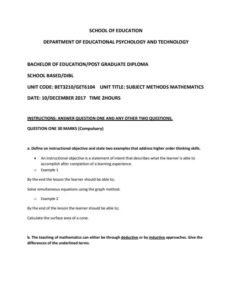
Below is the exam paper download link
Past Paper on Mathematics Subject Methods For Revision
Above is the exam paper download link
That is where Mathematics Subject Methods comes in. It’s the bridge between high-level content and the art of pedagogy. It’s about learning how to dismantle complex theories and rebuild them in a student’s mind. However, because this unit blends psychology, philosophy, and pure numbers, the exams can be surprisingly tricky.
The most effective way to shake off the “exam jitters” is to see exactly what the examiners are looking for. To help you gear up, we’ve put together a Q&A based on frequent exam themes, followed by a link to download a full revision paper.
The Pedagogy of Numbers: Revision Q&A
Q1: What is the difference between “Inductive” and “Deductive” teaching in a math context?
A: This is a classic “Section A” favorite.
-
Inductive Teaching: You start with specific examples and lead students to discover a general rule. For example, you show them several right-angled triangles, let them calculate the areas of squares on the sides, and eventually, they “discover” the Pythagorean Theorem.
-
Deductive Teaching: You start with the general rule and move to specific applications. You give them the formula
$$a^2 + b^2 = c^2$$and then show them how to solve for a missing side.
Q2: Why is the use of “Manipulatives” so emphasized in the modern syllabus?
A: Math is abstract, and for many learners, abstraction feels like a wall. Manipulatives (like Cuisenaire rods, abacuses, or geometric solids) provide a concrete bridge. According to Bruner’s Theory, students learn best when they move through three stages: Enactive (physical action), Iconic (using images), and finally Symbolic (abstract notation).
Q3: How do you handle “Common Misconceptions” in a lesson plan?
A: Examiners love to see that you can anticipate errors. A common one is “multiplication always makes numbers bigger” (which fails when using fractions or decimals). In your exam, if you are asked to design a lesson, always include a “Diagnostic” step where you check for these misconceptions before moving into the core of the topic.
Q4: What are the levels of ‘Bloom’s Taxonomy’ specifically for Math?
A: It’s not just about “remembering” formulas. A good math question should range from:
-
Recall: State the formula for the area of a circle.
-
Application: Find the area of a circle with a radius of 5cm.
-
Synthesis/Evaluation: If the area is doubled, what happens to the radius? (This tests higher-order thinking).
Why You Should Practice with This Past Paper
In a Mathematics Methods paper, you aren’t just calculating; you are justifying. Here is why downloading the resource below is essential:
-
Mastering the Lesson Plan: Most papers will ask you to draft a “40-minute lesson plan.” Practicing this helps you learn how to balance your time between the Set Induction (the hook), Lesson Development, and the Conclusion.
-
Applying Theory: You might know Piaget’s stages of development, but can you explain how they influence the teaching of “Place Value” to a 7-year-old? Past papers force you to apply theory to the classroom.
-
Marking Schemes: Seeing how marks are distributed helps you realize that “Showing your working” is just as important in a teaching exam as it is in a math exam.
Your Free Revision Resource
Ready to stop worrying and start teaching? We’ve curated a high-standard Mathematics Subject Methods Past Paper to help you refine your pedagogical approach.
[Download: Mathematics Subject Methods Revision Past Paper (PDF)]
(Pro-tip: When revising, don’t just read the questions. Grab a pen and actually draw the “Tree Diagrams” or “Geometric Proofs” you’d use on a chalkboard. Visualizing your board work is half the battle!)
Final Thoughts
Mathematics is the “Queen of Sciences,” and your job as a teacher is to make her accessible to everyone. Use this past paper to find your weak spots—is it the psychology of learning or the practicalities of a scheme of work? Once you know, you can attack it.