Let’s be honest: Literary Theory can feel like a fever dream. One minute you’re enjoying a novel, and the next, you’re being asked to analyze it through the lens of “Post-Colonial Feminism” or “Structuralist Psychoanalysis.” It’s enough to make any student want to close the book for good.
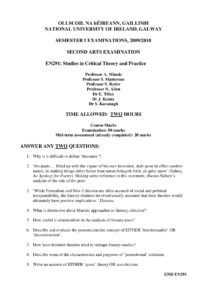
Below is the exam paper download link
Past Paper On Literary Theory And Analysis For Revision
Above is the exam paper download link
But here is the secret: Literary theory isn’t about making simple stories complicated. It’s about power. It’s about looking at a text and asking, “Who has the power here, and why?” Once you learn the different “glasses” you can wear to look at a book, the subject becomes a fascinating game of perspective.
To help you get ready for the exam, we’ve tackled the most common hurdles found in literary analysis papers.
The Revision Q&A: Thinking Like a Critic
Q: What is the point of ‘Literary Theory’? Why can’t I just analyze the plot? Plot is just the “what.” Theory is the “why.” Examiners aren’t testing if you read the book; they are testing if you can think critically. Theory gives you a framework to discuss things like gender, class, and history. If you only talk about what happened in the story, you’re stuck in a low-grade bracket. To move up, you need to use a “critical lens.”
Q: I keep getting ‘Formalism’ and ‘New Criticism’ mixed up. Are they the same? Essentially, yes. Both schools of thought tell you to ignore the author. They don’t care about the author’s life or the time period the book was written in. They only care about the words on the page. In an exam, if you’re asked to do a “Formalist Analysis,” focus on irony, paradox, and metaphor within the text itself. Don’t mention history!
Q: How do I handle a ‘Marxist’ reading of a text? Don’t panic—you don’t need to be a political expert. Just follow the money. A Marxist reading looks at the socio-economic status of the characters. Ask yourself:
-
Who owns the land or the business?
-
Who is working for whom?
-
Is the “lower class” being oppressed or celebrated? If you can identify the “class struggle,” you’ve successfully applied the theory.
Q: What is ‘Deconstruction,’ and why is it so confusing? Deconstruction (championed by Jacques Derrida) is the art of finding contradictions. It argues that language is slippery and that a text often “undoes” itself. If a book claims to be about “Order,” a deconstructionist will look for all the ways “Chaos” is actually present. In your revision, look for binary oppositions (Light vs. Dark, Good vs. Evil) and show how the line between them is actually blurry.
Why You Need to Download the Past Paper
You can memorize the definitions of “Queer Theory” or “Eco-criticism” all day, but until you have to apply them to an unseen poem or a short story excerpt, you haven’t truly revised.
By using our downloadable past paper, you will:
-
Master the ‘Application’ Phase: Learn how to take a quote and explain it using three different theories.
-
Practice Technical Terminology: Use words like hegemony, patriarchy, and signifier correctly. The more “academic” your vocabulary, the higher your marks.
-
Refine Your Essay Structure: Theory essays require a very specific flow—Introduction, Theoretical Framework, Analysis, and Conclusion. Practicing with a past paper ensures you don’t ramble.
Download Your Revision Resource
Ready to stop being a passive reader and start being a critical thinker? Don’t leave your exam to chance. Use the link below to download a full Literary Theory and Analysis past paper. Set your timer, pick a lens, and start writing.
[Click Here to Download the Literary Theory and Analysis Past Paper]
A Quick Parting Tip: The ‘Author is Dead’ Rule
When you’re writing your analysis, try to avoid saying “The author intended to…” or “The author felt…” Instead, say “The text suggests…” or “The narrative reveals…” It makes your argument sound more objective and professionally academic!