Ask any veteran teacher, and they’ll tell you: knowing your subject is only half the battle. The real magic—and the real struggle—is in the “how.” General Instructional Methods is the heartbeat of any Education degree. It’s the toolkit that turns a subject expert into a master communicator.
Below is the exam paper download link
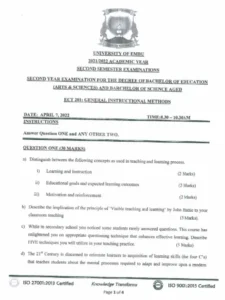
Past Paper On General Instructional Methods For Revision
Above is the exam paper download link
Whether you are trying to wrap your head around Gagne’s Nine Events of Instruction or debating the merits of Teacher-Centered versus Learner-Centered approaches, the theory can feel incredibly abstract until you see it in an exam setting. That is where past papers come in. They take those “fancy” pedagogical terms and put them into real-world classroom scenarios.
To help you move from theory to practice, we’ve put together a specialized Q&A session based on the questions that pop up year after year, followed by a link to download a full revision paper.
Master the Classroom: Key Revision Q&A
Q1: What is the fundamental difference between “Pedagogy” and “Andragogy”?
A: This is a Section A favorite.
-
Pedagogy is the art and science of teaching children. It is often teacher-directed, as the teacher is responsible for what, when, and how things are learned.
-
Andragogy is the method used to teach adults. It assumes that the learner is self-directed and brings a wealth of experience to the classroom, requiring a more collaborative approach.
Q2: When should a teacher choose “Direct Instruction” over “Inquiry-Based Learning”?
A: It depends on your objective. Direct Instruction (lectures, demonstrations) is excellent for introducing foundational facts or teaching high-risk procedures (like safety in a lab). Inquiry-Based Learning (projects, problem-solving) is better for developing critical thinking and allowing students to “own” the knowledge, though it takes much more time.
Q3: Explain the “Rule of Three” in Lesson Presentation.
A: In instructional design, the Rule of Three suggests that students need to hear or interact with a concept at least three times to move it into long-term memory:
-
Tell them what you’re going to tell them (The Set Induction/Introduction).
-
Tell them (The Lesson Development).
-
Tell them what you told them (The Conclusion/Summary).
Q4: Why is “Formative Assessment” considered more important than “Summative Assessment” during the term?
A: Think of it this way: When the cook tastes the soup, that’s Formative (you can still add salt!). When the guests taste the soup, that’s Summative (the grade is final). Formative assessment happens during the learning process, allowing the teacher to adjust their methods if the students are confused.
The Strategy: Why Download This Past Paper?
You can read a textbook a hundred times, but an exam is a test of application. Here is why downloading the resource below is a game-changer:
-
Mastering the “Verb”: Does the question ask you to Define, Contrast, or Critically Evaluate? Each requires a different level of depth. Past papers teach you how to “scale” your answers.
-
Drafting on the Fly: Many papers ask you to “Sketch a 40-minute lesson plan for a topic of your choice.” Practicing this ensures you don’t forget the “Rationale” or “Instructional Aids” sections under pressure.
-
Timing Your Performance: Education papers are notoriously long. Practicing with a real paper helps you learn how much time to give to the 5-mark definitions versus the 20-mark essay questions.
Your Free Revision Resource
Ready to stop “studying” and start “preparing”? We’ve sourced a comprehensive General Instructional Methods Past Paper that covers everything from classroom management to the psychology of learning.
[Download: General Instructional Methods Revision Past Paper (PDF)]
(Pro-tip: When you finish the paper, go back and look at your “Instructional Media” section. Are you still only suggesting “charts and chalk”? Modern papers look for mentions of ICT, simulation software, and collaborative digital tools!)
Final Thoughts
Great teachers aren’t born; they are trained. Mastering instructional methods is the first step toward creating a classroom where students don’t just “hear” but actually “learn.” Download the paper, test your knowledge, and walk into that exam room with a plan.