Let’s be honest: when we think about school, we usually think about math problems, history dates, or the cafeteria menu. But for a sociologist, the classroom is a high-stakes arena where power, culture, and identity collide.
Below is the exam paper download link
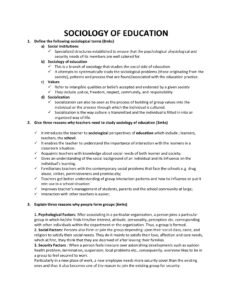
Past paper on Educational Sociology For Revision
Above is the exam paper download link
Educational Sociology isn’t just about observing students; it’s about asking the uncomfortable questions. Does education really create equality, or does it just reinforce the status quo? Why do some kids succeed while others are left behind before they even pick up a pencil? If you’re preparing for an exam in this field, you need to stop thinking like a student and start thinking like a social architect.
To help you get into that mindset, we’ve tackled the big questions that dominate the “Sociology of Education” past papers.
The Revision Q&A: Deconstructing the System
Q: What is the ‘Hidden Curriculum,’ and why do examiners love it? This is a staple in every sociology paper. The hidden curriculum refers to the unwritten, unofficial lessons students learn—like obedience to authority, gender roles, and the value of competition. While the official curriculum teaches you algebra, the hidden one teaches you how to be a “compliant worker.” If an exam asks about the role of schools in a capitalist society, this should be your first point of call.
Q: How do Functionalists and Conflict Theorists view education differently? Think of this as the ultimate heavyweight match:
-
Functionalism (Durkheim/Parsons): Sees education as the “social glue.” It teaches shared values and sifts people into jobs based on talent (Meritocracy).
-
Conflict Theory (Marx/Bourdieu): Sees education as a tool used by the elite to stay in power. It argues that schools actually promote inequality by favoring the culture of the wealthy.
Q: What does Pierre Bourdieu mean by ‘Cultural Capital’? This is the “secret sauce” of social mobility. Cultural capital isn’t about money in the bank; it’s about knowing the “right” way to speak, the “right” books to have read, and how to navigate middle-class institutions. Bourdieu argued that schools are biased toward children who already have this capital, giving them an unfair head start.
Q: Is ‘Meritocracy’ a myth or a reality? This is a frequent essay topic. Meritocracy is the idea that if you work hard, you will succeed regardless of your background. Sociologists often critique this by pointing to Social Reproduction—the way schools often ensure that children end up in the same social class as their parents.
The Power of the Past Paper: Your Social Roadmap
You can read about “Social Stratification” for hours, but sociology is a subject that rewards sharp, critical argumentation. You need to know how to use theory to explain real-world statistics about race, class, and gender in the school system.
By downloading our Educational Sociology past paper, you will:
-
Master the Jargon: Practice using terms like Socialization, Ideological State Apparatus, and Symbolic Violence in the right context.
-
Refine Your Comparative Skills: Learn how to pit different theorists against each other to build a balanced, high-scoring essay.
-
Spot the Trends: You’ll notice that questions on the Digital Divide and Gender Achievement Gaps are becoming standard in modern papers.
Download Your Revision Resource Here
Ready to pull back the curtain on the education system? Don’t leave your grades to chance. The best way to build your confidence is to tackle the structural questions that have challenged sociologists for years. Use the link below to download a curated Educational Sociology past paper.
[Click Here to Download the Educational Sociology Past Paper for Revision]

A Quick Parting Tip: The ‘Labeling Theory’ Trick
If an exam asks about why certain students underperform, mention Labeling Theory (Becker). This is the idea that when a teacher “labels” a student as a troublemaker, the student internalizes that label, leading to a Self-Fulfilling Prophecy. It’s a powerful micro-sociological point that shows you understand how individual interactions shape lives!