Let’s be honest: when you look at a school system, it’s easy to see the teachers and the students. But what’s harder to see is the invisible scaffolding holding it all up—the Educational Planning. It is the art of predicting how many desks we’ll need in five years, which subjects will drive the economy in ten, and how to pay for it all without breaking the bank.
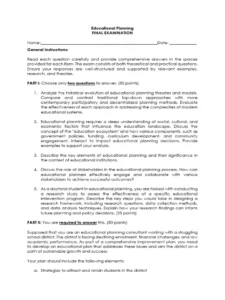
Below is the exam paper download link
Past Paper On Educational Planning For Revision
Above is the exam paper download link
If you are staring down a final paper in this field, you know it’s a heavy mix of economics, sociology, and pure logistics. It’s not just about “having a plan”; it’s about understanding the complex methodologies used to build nations. To help you move from a “vague idea” to a “distinction-grade” answer, we’ve tackled the big questions that frequently define the pass mark in recent past papers.
The Revision Q&A: Thinking Like a Strategic Planner
Q: What are the three main approaches to Educational Planning? This is the “Holy Trinity” of the subject. In your exam, you must be able to distinguish between:
-
Social Demand Approach: Planning based on how many people want to go to school. It treats education as a right.
-
Manpower Requirement Approach: Planning based on what the economy needs (e.g., “We need 5,000 more engineers”).
-
Cost-Benefit Analysis: Planning based on the return on investment. Is a dollar spent on primary schools more effective than a dollar spent on a university?
Q: Why is ‘Sustainability’ the biggest challenge in modern planning? In 2026, planners are no longer just looking at enrollment numbers. They are looking at Climate Resilience and Economic Stability. If a plan relies on a one-time foreign grant to build schools but doesn’t have a budget for teacher salaries in year three, the plan isn’t sustainable. When answering, use the term “Recurrent Costs”—it shows you understand the long-term fiscal reality.
Q: What is the difference between ‘Top-Down’ and ‘Bottom-Up’ Planning?
-
Top-Down: Decisions made at the Ministry of Education and passed down. It’s efficient but often ignores local needs.
-
Bottom-Up (Participatory): Planning that starts with teachers, parents, and local leaders. It takes longer but has much higher “buy-in” and success rates. If a past paper asks how to fix a failing literacy program, suggest moving toward a Decentralized or Bottom-Up model.
Q: How do ‘Demographic Trends’ dictate a planner’s work? You can’t plan if you don’t know the numbers. Planners look at Birth Rates, Migration Patterns, and Mortality. If the birth rate is dropping but you are building new primary schools, your plan is flawed. In your exam, mention the “Age-Dependency Ratio” to prove you understand how population structure impacts educational funding.
The Power of the Past Paper: Your Strategic Roadmap
Reading about “Linear Programming” or “School Mapping” is one thing, but Educational Planning is a technical discipline. You need to know how to interpret a Population Pyramid or justify a budget cut under a strict 45-minute timer.
By downloading our Educational Planning past paper, you will:
-
Master the Terminology: Practice using terms like Wastage Rates, Internal Efficiency, and Human Capital in the right context.
-
Refine Your Calculation Skills: Many papers ask you to calculate Gross vs. Net Enrollment Ratios. Doing this at home first prevents a mid-exam meltdown.
-
Identify Trends: You’ll notice that questions on Inclusive Education and Digital Infrastructure are becoming standard features in recent papers.
Download Your Revision Material Here
Ready to move from a student to a system architect? Don’t leave your grades to the “shifting winds” of chance. The best way to build your confidence is to tackle the strategic puzzles that have challenged planners for decades. Use the link below to download a curated Educational Planning past paper.
[Click Here to Download the Educational Planning Past Paper]

A Quick Parting Tip: The ‘Flexibility’ Rule
Whenever you are asked to critique a plan, always check for Flexibility. A plan that is too rigid will break when the economy changes or a new technology emerges. Suggesting a “Rolling Plan” (one that is updated every year) shows the marker that you understand that the real world is unpredictable!