If you are a student-teacher, you’ve likely realized that knowing the parables of Jesus or the history of the Israelite monarchy is only half the battle. The real challenge lies in CRE Subject Methods—the unit that teaches you how to make ancient biblical truths resonate with a modern, tech-savvy teenager.
Below is the exam paper download link
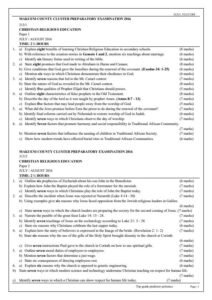
Past Paper On CRE Subject Methods For Revision
Above is the exam paper download link
Christian Religious Education (CRE) is unique because it bridges the gap between academic knowledge and moral development. It’s not just about passing on facts; it’s about fostering critical thinking and life skills. However, the exams for this unit can be notoriously tricky because they don’t just test your faith—they test your instructional logic.
To help you move from a student mindset to a professional educator, we’ve put together a specialized Q&A session based on the questions that appear year after year, followed by a link to download a full revision paper.
The Pedagogy of Faith: Revision Q&A
Q1: Why is the “Life Approach” considered the gold standard for teaching CRE?
A: This is a fundamental exam question. The Life Approach starts with the learner’s daily experiences (joys, challenges, or social issues) and then connects them to the Biblical message. In an exam, emphasize that this makes the subject relevant. Instead of starting with “Abraham’s call,” you start with the concept of “leaving home for a new journey,” making the scripture a solution to a real-life situation.
Q2: How do you handle “Sensitive Topics” like HIV/AIDS or Gender Roles in a CRE classroom?
A: This is a “Values Education” question. A high-scoring answer focuses on creating a safe, non-judgmental environment. You must explain that the teacher’s role is to facilitate a dialogue between cultural norms and Christian ethics. Use Scaffolding: start with what the community says, present the Biblical perspective, and allow students to reflect on the middle ground.
Q3: What are the advantages of using “Dramatization” over a standard Lecture?
A: While lectures cover more content quickly, Dramatization (role-playing) engages the “affective domain.” When students act out the story of the Good Samaritan, they don’t just hear about empathy—they feel the tension of the characters. In your revision, mention that this caters to different learning styles, specifically kinesthetic and auditory learners.
Q4: How does a teacher use “Audio-Visual Aids” effectively in a rural school with limited resources?
A: Examiners love “Resourcefulness.” If you don’t have a projector, you can use high-quality charts, local radio broadcasts, or even guest speakers from the local church. The goal isn’t the “flashiness” of the tech; it’s the ability of the tool to make an abstract concept (like “The Holy Spirit”) more concrete for the learner.
Why You Should Practice with This Past Paper
In a CRE Methods paper, you are often asked to “Draft a 40-minute lesson plan for a Form 2 class on the topic of Christian Approaches to Work.” You cannot wing this. Here is why downloading the resource below is a game-changer:
-
Mastering the Objectives: You’ll see exactly how to write SMART objectives (Specific, Measurable, Achievable, Relevant, and Time-bound).
-
Predicting the “Application” Questions: Past papers show you how to link the Bible to contemporary issues like environmental conservation or corruption.
-
Time Management: Pedagogy papers are often “essay-heavy.” Practicing helps you learn how to structure your points without losing marks for lack of detail.
Your Free Revision Resource
Ready to stop “reading about teaching” and start “preparing to teach”? We have curated a comprehensive CRE Subject Methods Past Paper to help you refine your pedagogical approach and walk into the exam room with total confidence.
[Download: CRE Subject Methods Revision Past Paper (PDF)]
(Pro-tip: When revising, don’t just write out the answers. Practice sketching the “Seven Dimensions of Religion” or a “Social Problem-Solving Tree” as you would on a chalkboard. Examiners love to see that you can visualize your teaching!)
Final Thoughts
Teaching CRE is about more than just passing an exam; it’s about shaping the character of the next generation. Use this past paper to find your weak spots—is it the lesson plan format or the evaluation techniques? Once you know, you can master it.