If you are a student-teacher, you already know that being a “Chemistry person” and being a “Chemistry teacher” are two very different states of matter. You might understand the nuances of the Haber Process, but can you explain it to a distracted teenager who is more interested in the Bunsen burner flame than the equilibrium constants?
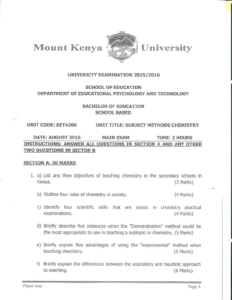
Below is the exam Paper download link
Past Paper On Chemistry Subject Methods For Revision
Above is the exam paper download link
Chemistry Subject Methods is the unit that bridges the gap between your content knowledge and your pedagogical craft. It is where you learn how to turn abstract molecular theories into “Aha!” moments. The most effective way to transition from a student to an instructor is to test yourself against the very challenges you’ll face in the exam room.
To help you find your footing, we have put together a specialized Q&A session based on recurring exam themes, followed by a link to download a full revision paper.
The Pedagogy of Matter: Revision Q&A
Q1: What is the “Demonstration Method” in Chemistry, and when is it superior to individual practicals?
A: The demonstration method involves the teacher performing an experiment while the class observes. It is superior when the experiment involves highly toxic reagents (like concentrated Nitric acid), expensive materials, or complex setups where the risk of student error is high. In an exam, emphasize that a successful demo requires “vocalizing the process”—explaining the why behind every color change as it happens.
Q2: How do you use “Analogies” to teach abstract concepts like the Mole?
A: Chemistry is full of “invisible” concepts. A high-scoring answer focuses on using “Bridge Concepts.” For instance, comparing a Mole to a “dozen” or a “ream” of paper helps students visualize a specific quantity of particles. However, a good teacher always points out where the analogy fails—reminding students that while a dozen eggs are visible, a mole of atoms is not.
Q3: How should a teacher manage “Laboratory Safety” during a titration practical?
A: This is a staple question. Examiners look for a three-step safety plan:
-
Preparation: Checking for cracked glassware and ensuring eye-wash stations are accessible.
-
Instruction: Clearly demonstrating how to use a pipette filler (never mouth-pipette!) and how to handle indicators safely.
-
Disposal: Ensuring neutralized acids and bases are disposed of according to environmental standards.
Q4: Explain the importance of “Set Induction” in a Chemistry lesson.
A: Set induction is the “hook” at the start of the lesson. For a topic like Rates of Reaction, you might start by dropping an Alka-Seltzer tablet in cold water versus hot water. This immediate visual stimulus captures interest and provides a concrete anchor for the theoretical discussion on kinetic energy that follows.
Why You Should Practice with This Past Paper
In a Chemistry Methods paper, the examiner isn’t checking your ability to balance equations; they are checking your Instructional Design. Here is why downloading the resource below is a game-changer:
-
Mastering the Lesson Plan: You will almost certainly be asked to “Draft a 40-minute lesson on [Topic X].” Practicing this ensures you include the Rationale, Objectives, and Evaluation sections.
-
Predicting the Practical: Past papers show you which experiments are “exam favorites.” You’ll learn how to write out the “Apparatus and Reagents” list perfectly.
-
Bloom’s Taxonomy: You will learn how to write questions that move students from “Remembering” (naming an element) to “Creating” (designing an experiment to test for ions).
Your Free Revision Resource
Ready to stop “reading about teaching” and start “preparing to teach”? We have curated a high-standard Chemistry Subject Methods Past Paper to help you refine your pedagogical approach and boost your exam confidence.
[Download: Chemistry Subject Methods Revision Past Paper (PDF)]
(Pro-tip: When revising, practice sketching a “standard titration setup” or a “gas collection over water” diagram. Clear, labeled sketches on your exam script are a surefire way to impress the marker!)
Final Thoughts
Chemistry is a subject of transformation. By mastering the methods of teaching it, you aren’t just passing an exam; you are preparing to transform the way your future students see the world. Download the paper, test your timing, and walk into that exam room ready.