Let’s be honest: by the time you reach Advanced Statistical Methods, the “mean, median, and mode” of your undergrad days feel like a distant, happy memory. Now, you’re staring down the barrel of Multivariate Analysis, Path Diagrams, and Non-Parametric tests. It’s enough to make any education researcher reach for a double espresso.
Below is the exam paper download link
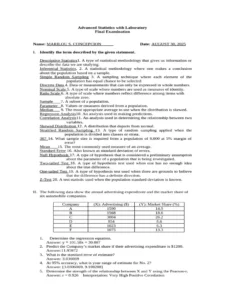
Past Paper On Advanced Statistical Methods In Education For Revision
Above is the exam paper download link
But here is the grounded truth: Advanced stats isn’t about being a math genius; it’s about being a master of inference. It’s about looking at a chaotic mess of student data and finding the hidden story that can actually change policy. To help you move from panic to precision, we’ve tackled the big, “high-point” questions that consistently appear in advanced revision papers.
The Revision Q&A: Mastering Complex Data
Q: When should I move from a Simple Regression to a Multiple Regression model? Think of it like predicting student success. A Simple Regression looks at one cause (e.g., “Does study time predict test scores?”). But we know life is messier than that. Multiple Regression allows you to look at several predictors at once—study time, socio-economic status, and previous grades—to see which one actually has the most “weight.”
Q: What is the difference between a One-Way ANOVA and a Factorial ANOVA? This is a classic exam “trap.”
-
One-Way ANOVA: You are comparing one factor (e.g., three different teaching methods).
-
Factorial ANOVA: You are looking at the interaction of two or more factors (e.g., three teaching methods AND whether the student is in an urban or rural school). In your exam, if the prompt mentions an “interaction effect,” you are almost certainly looking for a Factorial ANOVA.
Q: Why do we use Structural Equation Modeling (SEM) in education research? SEM is the “Grandmaster” of stats. It allows researchers to test complex relationships between “latent variables”—things we can’t measure directly, like “Motivation” or “Student Engagement.” By using SEM, you can see how these invisible forces lead to visible outcomes like graduation rates.
Q: How do I know if I should use a Parametric or Non-Parametric test? It all comes down to the “Normal Distribution.” If your data follows that classic, beautiful bell curve, use Parametric tests (like T-tests). If your data is skewed, small, or uses rankings (ordinal data), you need the Non-Parametric equivalent (like the Mann-Whitney U test).
The Power of the Past Paper: Your Calculation Roadmap
You can read about “Coefficient Alpha” until your eyes glaze over, but advanced stats is a “hands-on” sport. You need to know how to interpret an SPSS output table or justify a Type I Error under a ticking clock.
By downloading our Advanced Statistical Methods past paper, you will:
-
Master Output Interpretation: Practice reading “p-values,” “R-squared,” and “Standard Error” without the cold sweats.
-
Refine Your Logic: Learn how to choose the right test for the right research question—this is where the most marks are won or lost.
-
Identify Trends: You’ll notice that questions on Effect Size and Confidence Intervals are becoming more prominent in 2026 than simple significance testing.
Download Your Revision Material Here
Ready to turn that data dread into a distinction? Don’t leave your results to the “null hypothesis.” The best way to build your confidence is to tackle the multivariate puzzles that have challenged researchers for years. Use the link below to download a curated Advanced Statistical Methods in Education past paper.

A Quick Parting Tip: The ‘Assumption’ Check
In any advanced stats essay, always mention Assumptions. Before you run a test, you must check for Normality, Homogeneity of Variance, and Linearity. If you start your answer by saying, “First, I would test for the assumption of homoscedasticity,” you have already convinced the marker that you know exactly what you’re doing!