If you are studying Adult Education and Agriculture Extension, you aren’t just learning how to farm; you are learning how to be a catalyst for change. This unique field combines the psychology of adult learning (Andragogy) with the practical science of food production. However, when exam season rolls around, the sheer volume of “soft skills” and “hard sciences” can feel overwhelming.
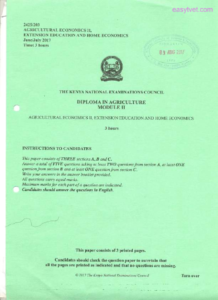
Below is the exam paper download link
Past Paper on Adult Education And Agriculture Extension for Revision
Above is the exam paper download link
To ensure you aren’t just memorizing facts but truly understanding the concepts, we’ve put together a specialized Q&A revision session. At the end of this post, you’ll find a link to download the full past paper to test your readiness.
Core Revision: Questions & Answers
Q1: How does “Andragogy” differ from “Pedagogy” in an agricultural context?
A: This is the most frequent question in any Adult Education paper.
-
Pedagogy is teacher-centered, usually applied to children who are dependent learners.
-
Andragogy is learner-centered. In agriculture extension, your “students” are often experienced farmers. They are self-directed, bring a wealth of practical life experience, and need to know why they are learning a new technique (like zero-grazing) before they adopt it.
Q2: What is the primary role of an Agricultural Extension Officer in community development?
A: The officer acts as a “bridge.” Their role is to translate complex scientific research (from universities or labs) into “farmer-friendly” language. They facilitate the adoption of new technologies, help farmers form cooperatives, and assist in problem-solving regarding pests, soil health, and market access.
Q3: Describe the “Demonstration Method” as a teaching tool for adult learners.
A: Adults learn best by doing. The Result Demonstration shows the outcome of a new practice (e.g., comparing a plot with fertilizer vs. one without), while a Method Demonstration shows how to do something (e.g., how to prune a coffee tree). It is effective because it provides visual proof and encourages immediate participation.
Q4: What are the main barriers to “Information Adoption” among rural farmers?
A: 1. Economic Constraints: Lack of capital to buy the required inputs. 2. Cultural Beliefs: Traditional methods are often deeply rooted. 3. Risk Aversion: Farmers living on the margin cannot afford a failed “experiment.” 4. Language Barriers: Technical jargon often alienates the target audience.
Why Practice with Past Papers?
You can read the textbooks cover-to-cover, but an exam tests your ability to apply that knowledge under pressure. Here is why you should download the paper below:
-
Mastering the “Action Verbs”: Does the question ask you to Highlight, Discuss, or Critically Evaluate? Each requires a specific depth of answer.
-
Identifying High-Yield Topics: You’ll notice that Maslow’s Hierarchy of Needs and Diffusion of Innovation models appear almost every year.
-
Time Management: Can you explain the Training and Visit (T&V) system in 15 minutes? Practicing with a timer is the only way to find out.
Download Your Revision Past Paper
We’ve compiled a high-standard past paper that covers everything from rural sociology to extension methodologies. Click the link below to download your copy:
[Download: Adult Education and Agriculture Extension Past Paper (PDF)]
(Tip: Treat this like a real exam. Turn off your phone, clear your desk, and try to answer the questions within the three-hour limit!)
Final Thoughts
Extension work is about empowering people to help themselves. Passing this exam is your first step toward becoming a leader in rural transformation. Don’t leave your grades to luck—use the resources available to you.