Second Language Acquisition (SLA) is a fascinating field that explores how people learn languages beyond their native tongue. Understanding the core theories—from the Contrastive Analysis Hypothesis to Krashen’s Monitor Model and Vygotsky’s Sociocultural Theory—is essential for linguistics and education students. This guide provides verified sources for downloading past papers in PDF format and answers the most frequently asked questions about the subject .
Below is the download link for the Revision Past Paper on Second Language Acquisition
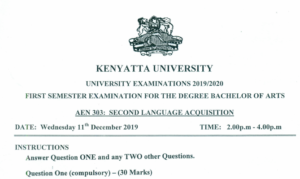
Past Paper on Second Language Acquisition
Above is the download link for Revision Past Paper on Second Language Acquisition
Where to Download Second Language Acquisition Past Papers
Past papers for this course are often made available through university repositories. The following is a list of verified sources where you can directly access past examination papers:
| Source | Institution | Course Code / Notes |
|---|---|---|
| Institutional Repository | Catholic University of Eastern Africa (CUEA) | ENG 302: Direct PDF download is available for this exam paper from the university’s repository . |
| Academic Exam Platform | Mount Kenya University (MKU) | BLA3111: The Aug 2018 Supplementary/Special exam paper is a great resource for understanding the typical question format . |
| Institutional Repository | TAR UMT (Malaysia) | BJES2053: Past year question paper for the October 2025 examination. Note: Access may be restricted to registered users of the institution . |
| Institutional Repository | NUST (Namibia) | SLA721S: A complete theory paper for a January 2023 supplementary examination is available for download. It’s an excellent example of a comprehensive exam . |
Important Note: When using past papers, always verify they align with your current syllabus. The most reliable papers are those directly from your university’s official past paper portal or library repository .
Frequently Asked Questions (FAQs) About Second Language Acquisition Past Papers
1. What are the major topics covered in these exams?
Based on a review of several past papers, the exams typically assess your understanding of foundational theories and concepts :

-
Key Theories: The Contrastive Analysis Hypothesis (CAH) , Error Analysis, Krashen’s Monitor Model, Universal Grammar, Acculturation Theory, and Sociocultural Theory.
-
Differences Between First and Second Language Acquisition: This is a very common essay question. You’ll need to distinguish between how children acquire their first language and how older learners approach a second one .
-
Key Concepts & Terminology: You will be tested on critical terms like Fossilization, Interlanguage, Positive and Negative Transfer, and Affective Factors .
-
Types of Errors: The exam often requires you to distinguish between Interlingual (influenced by the native language) and Intralingual errors (mistakes in the target language itself), as well as the difference between a mistake and an error .
2. What types of questions can I expect?
Past papers show a mix of question types designed to test both theoretical knowledge and practical application :
-
Multiple Choice Questions: Used to test your recall of specific facts, models, and theorists .
-
Short Answer/Term Definition: This often involves defining key concepts such as Fossilization or Positive Transfer .
-
True or False with Justification: A very common format for SLA papers, this tests your ability to identify a statement’s accuracy and explain why it’s correct or incorrect .
-
Discussion and Application: You may be asked to “Apply Krashen’s model of second language acquisition to the study of language” or “Diagnose the effectiveness of universal grammar” .

3. How can I effectively use past papers to study?
Using past papers strategically can significantly boost your exam performance:
-
Simulate Exam Conditions: Attempt a paper under timed conditions without your notes to practice time management and identify weak spots .
-
Check Your Work: Use your textbooks and lecture notes to verify your answers. For example, ensuring you correctly distinguish between “Cognitive inhibition” and “Attentional control” is key for accuracy .
-
Identify Recurring Themes: Look for topics that appear across multiple years. Krashen’s Monitor Model and the Differences Between L1 and L2 Acquisition are almost always assessed, so prioritize them in your revision .
4. What are the key textbooks I should use for revision?
The exam questions are typically based on a few standard, foundational SLA textbooks:
-
Ortega, L. (2009/2014). Understanding Second Language Acquisition. This is an authoritative and approachable introduction to the subject .
-
Gass, S. M. (2013). Second Language Acquisition: An Introductory Course. This is often listed as a required resource for SLA courses .
Back to Mpya News Home page: Education, Fashion, Law, business and sports
Last updated on: August 11, 2026
New information gained / new value takehome
- Note: Access may be restricted to registered users of the institution .
- Important Note: When using past papers, always verify they align with your current syllabus.
- Key Concepts & Terminology: You will be tested on critical terms like Fossilization, Interlanguage, Positive and Negative Transfer, and Affective Factors .
- Short Answer/Term Definition: This often involves defining key concepts such as Fossilization or Positive Transfer .
- Check Your Work: Use your textbooks and lecture notes to verify your answers.
- For example, ensuring you correctly distinguish between “Cognitive inhibition” and “Attentional control” is key for accuracy .
- Identify Recurring Themes: Look for topics that appear across multiple years.
- What are the key textbooks I should use for revision?
This content was developed using AI as part of our research process. To ensure absolute accuracy, all information has been rigorously fact-checked and validated by our human editor, Alex Munene.
External resource 1: Google Scholar Academic Papers
External resource 2: Khan Academy Test Prep
Reference 1: KNEC National Examinations
Reference 2: JSTOR Academic Archive
Reference 3: Shulefiti Revision Materials
Photo credit: instagram.com