Let’s be honest: being a leader in the world of sports is a bit of a balancing act. One half of your brain is a teacher, figuring out how to explain a complex zone defense to a distracted teenager (Pedagogy). The other half is a strategist, worrying about facility maintenance, budget allocations, and liability insurance (Management).
Below is the exam paper download link
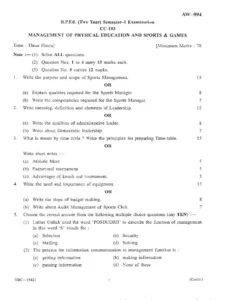
Past Paper On Sports Pedagogy And Management For Revision
Above is the exam paper download link
If you’re preparing for your final exams in this field, you know that the “X’s and O’s” of the game are only half the battle. You need to understand how people learn and how organizations breathe. To help you move from a “fan in the stands” to a “professional in the office,” we’ve tackled the big-ticket questions found in recent revision papers.
The Revision Q&A: Mastering the Field and the Front Office
Q: What is ‘Mosston’s Spectrum of Teaching Styles’ and why does it matter? In sports pedagogy, this is the gold standard. It’s a range that moves from “Command” (the coach makes all decisions) to “Discovery” (the athlete finds their own solutions).
In an exam, if you’re asked how to develop an athlete’s “game intelligence,” argue for a move toward the Discovery end of the spectrum. If you’re teaching a dangerous skill like the javelin throw, justify using the Command style for safety.
Q: How do I apply a ‘SWOT Analysis’ to a local sports club? Management papers love a good strategic tool.
-
Strengths: High community engagement.
-
Weaknesses: Aging equipment.
-
Opportunities: A new government grant for youth sports.
-
Threats: A rival club opening nearby.
When answering, don’t just list them—explain how the club can use its Strengths to capitalize on an Opportunity. That’s the “management” part of the answer.
Q: What is ‘Sport for Development’ (SfD)? This isn’t about winning trophies; it’s about using sports to solve social issues like health, gender equality, or peace-building. If a past paper asks you to design a community program, make sure your goals aren’t just “better soccer players,” but “better social cohesion.”
Q: What is the ‘Duty of Care’ in sports management? This is a high-point legal question. It’s the moral and legal obligation of a coach or manager to ensure the safety and well-being of participants. Mentioning Risk Assessment—the process of identifying hazards like a wet court or broken equipment before the whistle blows—shows the marker you understand the professional reality of the job.
The Power of the Past Paper: Your Professional Blueprint
You can read about “Transformational Leadership” all day, but Sports Pedagogy and Management is a practical discipline. You need to know how to draft a Code of Conduct or justify a Marketing Mix (the 4 P’s) for a sports event under a 45-minute timer.
By downloading our Sports Pedagogy and Management past paper, you will:

-
Master the Models: Practice applying Bridges’ Transition Model or the SMART Goals framework to real-world scenarios.
-
Refine Your Logic: Learn how to balance “Athlete-Centered” coaching with “Result-Oriented” management.
-
Identify Trends: You’ll notice that questions on Digital Marketing in Sports and Safeguarding Protocols are becoming standard features in 2026.
Download Your Revision Material Here
Ready to move from the locker room to the boardroom? Don’t leave your grades to “gut feeling” or luck. The best way to build your confidence is to tackle the pedagogical and organizational puzzles that have challenged sports leaders for years. Use the link below to download a curated past paper.
[Click Here to Download the Sports Pedagogy and Management Past Paper]
A Quick Parting Tip: The ‘Inclusion’ Rule
Whenever you’re asked to plan a sports session or manage a facility, always mention Inclusivity. Whether it’s adapting a drill for someone with a disability or ensuring a facility has gender-neutral changing rooms, showing that you think about “Sport for All” is a surefire way to pick up the extra points that lead to a distinction!
Back to Mpya News Home page: Education, Fashion, Law, business and sports

Last updated on: February 5, 2026
New information gained / new value takehome
- Opportunities: A new government grant for youth sports.
- It’s the moral and legal obligation of a coach or manager to ensure the safety and well-being of participants.
- Refine Your Logic: Learn how to balance “Athlete-Centered” coaching with “Result-Oriented” management.
- Back to Mpya News Home page: Education, Fashion, Law, business and sports Last updated on: February 5, 2026Mpya News Sitemap .
- News Education Rankings Reference 2: SNHU Distance Learning Reference 3: GCU University Programs Photo credit: instagram.
This content was developed using AI as part of our research process. To ensure absolute accuracy, all information has been rigorously fact-checked and validated by our human editor, Collins Murithi.