Let’s be honest: a great school isn’t just a collection of smart teachers and eager students. It is a complex machine that requires a skilled hand at the wheel. Educational Administration and Leadership is the study of that “hand.” It is where the grit of daily operations—budgets, schedules, and discipline—meets the grace of visionary leadership.
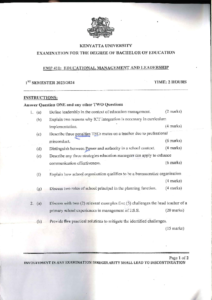
Below is the exam paper download link
Past Paper On Educational Adminstration And Leadership For Revision
Above is the exam paper download link
If you’re staring down a final exam in this field, you aren’t just memorizing definitions; you’re learning how to manage human potential and institutional resources. To help you move from a “managerial” mindset to a “leadership” one, we’ve tackled the big-ticket questions found in recent past papers.
The Revision Q&A: Leading with Purpose
Q: Is there a real difference between Administration and Management? This is a classic “Question One” favorite. Think of Administration as the “Brain”—it’s about policy-making, setting goals, and the broad legislative framework of the school. Management is the “Hands”—it’s the execution, the daily coordination, and the technical work of getting things done. In your exam, if you’re asked about a principal’s role, remember they must wear both hats.
Q: What are Henri Fayol’s five functions of administration? Even in 2026, Fayol is still the go-to theorist. His functions—Planning, Organizing, Commanding, Coordinating, and Controlling (POCCC)—are the bedrock of any admin essay.
When answering, don’t just list them; apply them. For example, “Controlling” in a school isn’t about being a dictator; it’s about evaluating teacher performance and student outcomes to ensure the plan is working.

Q: How do I choose between ‘Autocratic’ and ‘Democratic’ leadership in a case study? The “right” answer is usually Situational Leadership.
-
Autocratic: Useful in a crisis (e.g., an emergency drill).
-
Democratic: Essential for curriculum changes or morale-building.
-
Laissez-faire: Only works with highly expert, self-motivated staff. If a past paper gives you a scenario about a “divided staff,” argue for a Transformational approach—one that inspires change through a shared vision rather than just orders.
Q: What is ‘Organizational Culture,’ and why is it an admin priority? Culture is the “smell of the place.” It’s the unwritten rules about how people treat each other. A leader’s job is to move a school from a “Toxic Culture” (blame and silos) to a “Collaborative Culture” (trust and shared goals). Mentioning Edgar Schein’s Levels of Culture (Artifacts, Espoused Values, and Basic Assumptions) is a surefire way to grab those extra points.
The Power of the Past Paper: Your Administrative Blueprint
Reading about “Strategic Planning” is one thing, but Educational Administration is a practical science. You need to know how to solve a scheduling conflict, draft a budget justification, or handle a grievance procedure under a 45-minute timer.
By downloading our Educational Administration past paper, you will:
-
Master the Jargon: Practice using terms like Span of Control, Delegation, Chain of Command, and Accountability correctly.
-
Refine Your Decision-Making: Many papers ask you to be the “Acting Principal.” Practicing this helps you learn how to balance legal requirements with human empathy.
-
Identify Trends: You’ll notice that themes like Decentralization and Inclusive Leadership are becoming standard in modern papers.

Download Your Revision Material Here
Ready to turn your administrative theory into a top-tier grade? Don’t leave your leadership future to chance. The best way to build your confidence is to tackle the organizational puzzles that have challenged school leaders for years. Use the link below to download a curated past paper.
[Click Here to Download the Educational Administration and Leadership Past Paper]
A Quick Parting Tip: The ‘Span of Control’ Rule
Whenever you are asked how to improve school efficiency, mention the Span of Control. This refers to how many people a single administrator can effectively supervise. If a Principal has 50 teachers reporting directly to them, the system will fail. Suggesting “Middle Management” (like HODs) to narrow that span shows you understand the mechanics of a healthy organization!
Back to Mpya News Home page: Education, Fashion, Law, business and sports
Last updated on: February 4, 2026
New information gained / new value takehome
- For example, “Controlling” in a school isn’t about being a dictator; it’s about evaluating teacher performance and student outcomes to ensure the plan is working.
- Democratic: Essential for curriculum changes or morale-building.
- Back to Mpya News Home page: Education, Fashion, Law, business and sports Last updated on: February 4, 2026Mpya News Sitemap .
- News Education Rankings Reference 2: SNHU Distance Learning Reference 3: GCU University Programs Photo credit: instagram.
This content was developed using AI as part of our research process. To ensure absolute accuracy, all information has been rigorously fact-checked and validated by our human editor, Collins Murithi.