If you are a student-teacher, you know that Geography is perhaps the most “visual” subject in the curriculum. One day you are explaining the tectonic forces beneath the Earth’s crust, and the next, you are helping a student interpret the contour lines on a topographical map. But here is the catch: knowing how an oxbow lake forms is not the same as knowing how to teach it.
Below is the exam paper download link
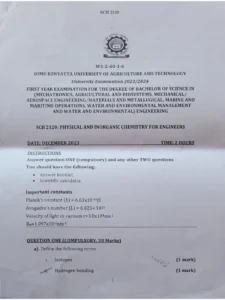
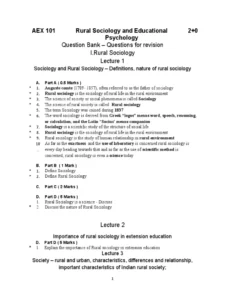
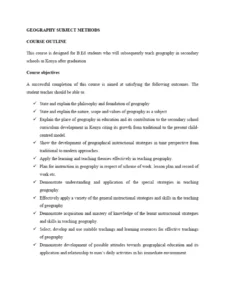
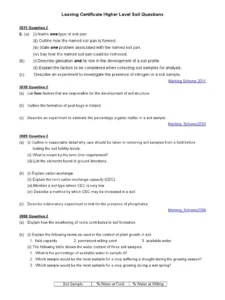
Past Paper On Geography Subject Methods For Revision
Above is the exam paper download link
Geography Subject Methods is the bridge between being a geographer and being an educator. It’s where you learn how to handle “fieldwork” logistics and how to use a globe to explain seasons to a confused teenager. To help you move from theory to a professional teaching license, we’ve put together a specialized Q&A session based on the questions that appear most frequently in exams.
The Pedagogy of Place: Geography Revision Q&A
Q1: What is the “Regional Approach” in Geography teaching, and when is it most effective?
A: This is a staple question. The regional approach involves studying a specific area (like the Rhine Rift Valley or the Canadian Prairies) as a whole unit, looking at the interaction between its physical and human features. It is most effective when teaching complex relationships—like how climate dictates the economic activities of a specific population. In an exam, contrast this with the “Topical Approach,” where you study one theme (like ‘Mining’) across the whole world.
Q2: How do you handle “Map Work” for students who find 3D visualization difficult?
A: Geography teachers often face “spatial anxiety” from students. A high-scoring answer focuses on the Concrete-to-Abstract transition. You start with 3D models (like a sand tray to show mountains) before moving to 2D photographs, and finally to the symbolic language of topographical maps.
Q3: Why is “Fieldwork” considered the “Laboratory of the Geographer”?
A: This is a classic “Philosophy of Geography” question. Fieldwork allows students to move beyond the textbook and interact with primary data. It fosters skills in observation, recording, and analysis. In your revision, remember to focus on the stages of fieldwork:
-
Preparation (Hypothesis and equipment).
-
Execution (Data collection).
-
Follow-up (Analysis and report writing).
Q4: How does a teacher use “Photographs” as a teaching aid without oversimplifying the lesson?
A: Photographs are powerful, but they can be deceptive. A good Geography method involves “Photo Interpretation.” You don’t just show a picture of a volcano; you ask students to identify the foreground, middle ground, and background, and to look for evidence of human activity (like farming on the fertile slopes). This turns a passive viewing into an active geographic inquiry.
Why You Should Practice with This Past Paper
In a Geography Methods paper, the examiner is checking your Instructional Design skills. You aren’t just drawing a map; you are explaining how you would teach a student to draw that map. Here is why the download below is vital:
-
Mastering the Lesson Plan: You will almost certainly be asked to draft a lesson plan for a topic like ‘Folding’ or ‘Internal Trade.’ Practicing this ensures you include your “Instructional Objectives” and “Evaluation” sections correctly.
-
Predicting the “Resource” Questions: Past papers show you which teaching aids are “exam favorites”—usually the globe, wall maps, and weather instruments.
-
Time Management: Geography methods papers are often long and require sketches. Practicing with a real paper helps you learn how much time to spend on a 5-mark definition versus a 20-mark “Plan a Field Trip” essay.
Your Free Revision Resource
Ready to stop “reading about teaching” and start “preparing to teach”? We have curated a high-standard Geography Subject Methods Past Paper to help you refine your pedagogical approach and boost your exam confidence.
[Download: Geography Subject Methods Revision Past Paper (PDF)]
(Pro-tip: When revising, practice sketching a “Cross-section of a Fold Mountain” or a “Rain Gauge” quickly. Clear, labeled sketches on your exam script are a surefire way to show the marker you have mastered visual instruction!)
Final Thoughts
Geography is the study of our home, and teaching it is a huge responsibility. By mastering these methods, you are preparing to help the next generation understand climate change, urban growth, and the beauty of our planet. Download the paper, test your timing, and walk into that exam room ready to lead.
Back to Mpya News Home page: Education, Fashion, Law, business and sports
Last updated on: January 27, 2026
New information gained / new value takehome
- ’ Practicing this ensures you include your “Instructional Objectives” and “Evaluation” sections correctly.
- [Download: Geography Subject Methods Revision Past Paper (PDF)] (Pro-tip: When revising, practice sketching a “Cross-section of a Fold Mountain” or a “Rain Gauge” quickly.
- Back to Mpya News Home page: Education, Fashion, Law, business and sports Last updated on: January 27, 2026Mpya News Sitemap .
- News Education Rankings Reference 2: SNHU Distance Learning Reference 3: GCU University Programs Photo credit: instagram.
This content was developed using AI as part of our research process. To ensure absolute accuracy, all information has been rigorously fact-checked and validated by our human editor, Collins Murithi.
