If you’ve ever felt overwhelmed by the sheer scale of Church History, you aren’t alone. We are talking about two thousand years of councils, crusades, schisms, and revivals. It is the story of how a small group in Jerusalem became a global movement, but for a student, it can feel like a mountain of names, dates, and complex Latin terms.
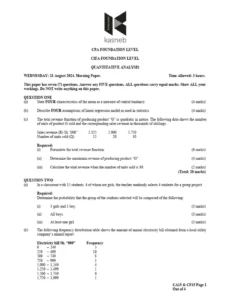
Below is the exam paper download link
Past Paper On Church History For Revision
Above is the exam paper download link
The trick to mastering Church History isn’t just memorizing when Martin Luther nailed his theses to a door; it’s understanding why he did it and what happened the next day. The most effective way to turn these historical stories into a passing grade is to practice with past papers. This allows you to see the “patterns” examiners love.
To help you get into the right frame of mind, we’ve put together a Q&A based on the heavy-hitters of the syllabus, followed by a link to download a full revision paper.
The Chronicles of Faith: Church History Q&A
Q1: What was the primary cause of the “Great Schism” of 1054?
A: This is a favorite “Section A” question. While there were many political tensions, the theological breaking point was the Filioque clause—a dispute over whether the Holy Spirit proceeds from the Father alone or from both the Father and the Son. This, combined with disagreements over the authority of the Pope in Rome versus the Patriarch in Constantinople, led to the permanent split between the Roman Catholic and Eastern Orthodox churches.
Q2: Why were the “Ecumenical Councils” so important to the Early Church?
A: Think of these councils as the “constitutional conventions” of Christianity. Councils like Nicaea (325 AD) and Chalcedon (451 AD) were called to settle heated debates about the nature of Christ. Was He fully God? Fully man? Both? Without these councils, the core doctrines of the Trinity and the Incarnation would not have been standardized.
Q3: How did the “Counter-Reformation” respond to Protestantism?
A: The Catholic Church didn’t just sit back. Through the Council of Trent, they clarified their doctrines, addressed corruption, and founded new orders like the Jesuits to spread the faith and improve education. In an exam, if you are asked about the “Catholic Reformation,” remember to focus on this internal renewal as much as the external fight against Protestantism.
Q4: What role did the “Industrial Revolution” play in 19th-century Church History?
A: This is a “Human Geography” meets “History” question. As people moved to cities, the Church had to adapt. This era saw the rise of the Social Gospel, the birth of the Salvation Army, and a new focus on labor rights and urban mission work. It proved that the Church’s history is always tied to the social changes of the time.
Why You Should Practice with This Past Paper
History is about more than just “what happened.” It’s about causality. Here is why downloading the resource below is a game-changer:
-
Spotting Recurring Themes: You’ll notice that questions on the Protestant Reformation and the Early Persecutions appear almost every year.
-
Perfecting the “Discuss” Essay: Church History exams usually require long-form answers. Practicing with a past paper helps you learn how to argue a point—for example, “To what extent was the Printing Press responsible for the Reformation?”
-
Terminology Precision: Do you know the difference between Monasticism, Scholasticism, and Humanism? Using these terms correctly is the fastest way to impress an examiner.
Download Your Revision Material
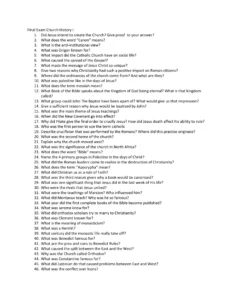
Ready to ace your finals? We have curated a comprehensive Church History Past Paper that covers everything from the Apostolic Age to the modern Ecumenical movement.
[Download: Church History Revision Past Paper (PDF)]
(Pro-tip: When revising, try to create a “Parallel Timeline.” On one side, put Church events; on the other, put secular world events. Seeing how the fall of the Roman Empire coincided with the rise of the Papacy makes the history much easier to remember!)
Final Thoughts
Church History is the story of people trying to live out their faith in a changing world. By mastering these papers, you are gaining a deeper perspective on the world we live in today. Download the paper, grab your highlighters, and start connecting the dots.
Back to Mpya News Home page: Education, Fashion, Law, business and sports
Last updated on: January 27, 2026
New information gained / new value takehome
- Q2: Why were the “Ecumenical Councils” so important to the Early Church?
- Through the Council of Trent, they clarified their doctrines, addressed corruption, and founded new orders like the Jesuits to spread the faith and improve education.
- In an exam, if you are asked about the “Catholic Reformation,” remember to focus on this internal renewal as much as the external fight against Protestantism.
- This era saw the rise of the Social Gospel, the birth of the Salvation Army, and a new focus on labor rights and urban mission work.
- [Download: Church History Revision Past Paper (PDF)] (Pro-tip: When revising, try to create a “Parallel Timeline.
- Back to Mpya News Home page: Education, Fashion, Law, business and sports Last updated on: January 27, 2026Mpya News Sitemap .
- News Education Rankings Reference 2: SNHU Distance Learning Reference 3: GCU University Programs Photo credit: instagram.
This content was developed using AI as part of our research process. To ensure absolute accuracy, all information has been rigorously fact-checked and validated by our human editor, Collins Murithi.