Studying the Origin and Development of Islam is a journey through time, starting from the rugged deserts of 7th-century Arabia to the establishment of one of the world’s most influential civilizations. This unit isn’t just about dates and names; it’s about understanding the socio-political climate of Pre-Islamic Arabia (Jahiliyyah), the divine revelations at Cave Hira, and the strategic leadership that led to the expansion of the Islamic empire.
Below is the exam paper download link
Past Paper On Origin And Development Of Islam For Revision
Above is the exam paper download link
However, when you are staring at an exam script, the challenge is often in the details. How do you distinguish between the Meccan and Medinan phases of the Prophet’s mission? How do you analyze the contributions of the four Rightly Guided Caliphs (Khulafa-ur-Rashidun)? The most effective way to build your confidence is to “interrogate” the subject through past papers.
To help you get started, we’ve put together a specialized Q&A session based on recurring exam themes, followed by a link to download a full revision paper.
Understanding the Roots: Key Revision Q&A
Q1: What were the social and religious conditions of Pre-Islamic Arabia (Jahiliyyah)?
A: This is a classic “Context” question. Arabia was characterized by tribalism, where loyalty to the clan was supreme. Religiously, most Arabs were polytheistic, worshipping idols housed in the Ka’bah. Socially, issues like female infanticide and usury were prevalent. In your exam, emphasize that Islam didn’t just bring a new religion; it brought a radical social revolution that championed equality and monotheism (Tawhid).

Q2: Describe the significance of the Hijrah (Migration to Medina) in 622 AD.
A: The Hijrah is the turning point in Islamic history. It marks the transition of the Muslims from a persecuted minority in Mecca to a self-governing community (Ummah) in Medina. It was in Medina that the first Islamic state was established, and the “Medinan Surahs” began to focus on law, governance, and social conduct. This event is so significant that it marks the beginning of the Islamic calendar.
Q3: Who were the ‘Rightly Guided Caliphs’ and what was their primary challenge?
A: These were the first four leaders after the Prophet’s death: Abu Bakr, Umar, Uthman, and Ali. Their primary challenge was maintaining unity. For instance, Abu Bakr dealt with the Ridda Wars (Apostasy Wars), while Umar focused on the administrative expansion of the empire into Persia and Byzantium. In an exam, you should be able to mention at least one specific contribution for each Caliph.
Q4: How did the Compilation of the Quran happen?
A: This is a high-frequency technical question. You should mention that while the Quran was written on various materials during the Prophet’s life, it was formally compiled into a single volume (Mushaf) during the caliphates of Abu Bakr (initial compilation) and Uthman (standardization of the dialect to prevent confusion).
Why You Should Practice with This Past Paper
History is a narrative, and an exam tests how well you can tell that story accurately. Here is why downloading the resource below is a game-changer:
-
Refining Your Chronology: Many students lose marks by mixing up the order of the Battles (Badr, Uhud, Khandaq). Past papers help you fix these events in a logical sequence.
-
Mastering the Terminology: Do you know the difference between Muhajirun (Emigrants) and Ansar (Helpers)? Or the significance of the Constitution of Medina? Using these terms correctly shows the examiner you have deep subject knowledge.
-
Structuring the “Discuss” Questions: History papers often ask you to “Discuss the impact of…” These aren’t just one-paragraph answers. Practicing with past papers helps you build a multi-point argument.
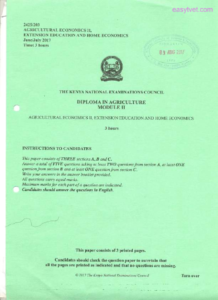
Download Your Revision Material
Ready to ace your Islamic History exam? We have provided a comprehensive past paper on the Origin and Development of Islam to help you refine your answers and broaden your historical perspective.
[Download: Origin and Development of Islam Revision Past Paper (PDF)]
(Pro-tip: When revising, try to draw a family tree of the Quraysh tribe. Understanding the relationships between the major figures makes the political history of early Islam much easier to grasp!)
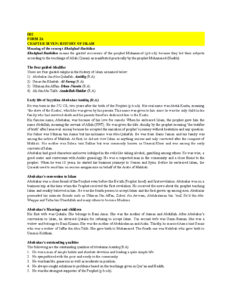
Final Thoughts
The story of Islam is a story of resilience and transformation. By mastering this unit, you aren’t just preparing for a test; you are understanding the foundations of a global faith. Download the paper, identify your weak spots, and go back to your notes to fill in the gaps.
Back to Mpya News Home page: Education, Fashion, Law, business and sports
Last updated on: January 27, 2026
New information gained / new value takehome
- Understanding the Roots: Key Revision Q&A Q1: What were the social and religious conditions of Pre-Islamic Arabia (Jahiliyyah)?
- In your exam, emphasize that Islam didn’t just bring a new religion; it brought a radical social revolution that championed equality and monotheism (Tawhid).
- This event is so significant that it marks the beginning of the Islamic calendar.
- [Download: Origin and Development of Islam Revision Past Paper (PDF)] (Pro-tip: When revising, try to draw a family tree of the Quraysh tribe.
- Download the paper, identify your weak spots, and go back to your notes to fill in the gaps.
- Back to Mpya News Home page: Education, Fashion, Law, business and sports Last updated on: January 27, 2026Mpya News Sitemap .
- News Education Rankings Reference 2: SNHU Distance Learning Reference 3: GCU University Programs Photo credit: instagram.
This content was developed using AI as part of our research process. To ensure absolute accuracy, all information has been rigorously fact-checked and validated by our human editor, Collins Murithi.