Studying African Religion and Culture (ARC) is more than just an academic exercise; it is an exploration of the worldview, philosophy, and social fabric that has sustained the continent for millennia. Unlike Western theological studies, African Traditional Religion (ATR) is lived, not just read. It is found in the community, the land, and the rhythm of daily life.
Below is the exam paper download link
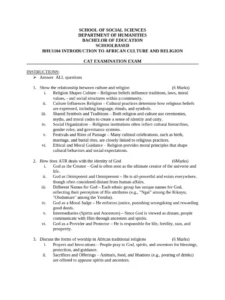
Past Paper On Introduction To African Religion And Culture For Revision
Above is the exam paper download link
However, when you face an exam paper on this subject, the challenge is often translating these “lived” experiences into structured, academic arguments. How do you define the role of the “Living Dead”? How do you explain the African concept of time? The secret to scoring an A is practicing with past papers that force you to think like a scholar of African heritage.
To help you get started, we’ve put together a specialized Q&A session based on recurring exam themes, followed by a link to download a full revision paper.
Understanding the Roots: Key Revision Q&A
Q1: Why is African Traditional Religion (ATR) described as “not a religion of the book”?
A: This is a fundamental concept. ATR is an oral tradition. Its tenets are not found in a single holy book like the Bible or the Quran. Instead, the “scriptures” are written in the hearts, songs, rituals, myths, and proverbs of the people. In an exam, emphasize that ATR is inseparable from the culture; to live the culture is to practice the religion.

Q2: Who are the “Living Dead” according to John Mbiti?
A: This is a high-frequency question! The “Living Dead” are the ancestors who died recently (up to five generations ago) and are still remembered by name by the living. They act as intermediaries between the Supreme Being and humanity. They are “living” because they are still part of the family conversations and rituals, and “dead” because they have physically left the world.
Q3: What is the significance of “Rites of Passage” in African communities?
A: Rites of passage—Birth, Initiation, Marriage, and Death—are the stages through which a person becomes a full member of society. Initiation is particularly crucial in exams; it marks the transition from childhood to adulthood. It involves physical endurance, secret teachings, and the “shedding” of the old self to take on new responsibilities for the community.
Q4: How does the African concept of “Community” differ from Western Individualism?
A: This is often summarized by the phrase “Ubuntu” (I am because we are). In African culture, an individual does not exist in isolation. You belong to a family, a clan, and an ethnic group. Religious practices are usually communal rather than private. In an exam, discuss how moral failures are seen as affecting the whole community, not just the individual.
Why You Should Practice with This Past Paper
Theology and Culture papers require you to provide specific examples from different African ethnic groups (e.g., the Yoruba of Nigeria, the Gikuyu of Kenya, or the Zulu of South Africa). Here is why downloading the resource below is vital:
-
Refining Your Definitions: Do you know the difference between a Medicine Man, a Medium, and a Rainmaker? Past papers help you distinguish these roles clearly.
-
Mastering the Concept of Time: Many students struggle with Mbiti’s concept of Sasa (The Now) and Zamani (The Past). Practicing essay questions on this topic is the only way to get it right.
-
Structuring Your Essay: ARC exams often ask for “The role of…” or “The significance of…” Practicing with a past paper helps you build a strong introduction, thematic body paragraphs, and a reflective conclusion.

Download Your Revision Material
Ready to connect with your roots and pass your exams? We have provided a comprehensive past paper on Introduction to African Religion and Culture that covers all major themes from the Supreme Being to modern challenges facing ATR.
[Download: African Religion and Culture Revision Past Paper (PDF)]
(Pro-tip: When revising, try to find a proverb from your own community that relates to a religious theme. Using local proverbs in your exam answers shows the examiner that you truly understand the “depth” of the subject!)
Final Thoughts
African Religion and Culture is the foundation upon which our modern identities are built. By mastering this unit, you aren’t just getting a certificate; you are becoming a guardian of our heritage. Download the paper, identify the patterns, and walk into that exam room with the wisdom of the ancestors.
Back to Mpya News Home page: Education, Fashion, Law, business and sports
Last updated on: January 27, 2026
New information gained / new value takehome
- Understanding the Roots: Key Revision Q&A Q1: Why is African Traditional Religion (ATR) described as “not a religion of the book”?
- They are “living” because they are still part of the family conversations and rituals, and “dead” because they have physically left the world.
- It involves physical endurance, secret teachings, and the “shedding” of the old self to take on new responsibilities for the community.
- A: This is often summarized by the phrase “Ubuntu” (I am because we are).
- [Download: African Religion and Culture Revision Past Paper (PDF)] (Pro-tip: When revising, try to find a proverb from your own community that relates to a religious theme.
- Back to Mpya News Home page: Education, Fashion, Law, business and sports Last updated on: January 27, 2026Mpya News Sitemap .
- News Education Rankings Reference 2: SNHU Distance Learning Reference 3: GCU University Programs Photo credit: instagram.
This content was developed using AI as part of our research process. To ensure absolute accuracy, all information has been rigorously fact-checked and validated by our human editor, Collins Murithi.