If you are a student-teacher, you’ve likely realized that being good at math and being good at teaching math are two very different things. Mathematics Subject Methods is the bridge between those two worlds. It’s the unit where you stop focusing on solving for $x$ and start focusing on why your future students might be afraid of $x$ in the first place.
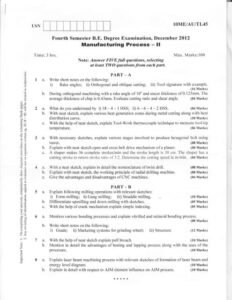
Below is the exam paper download link
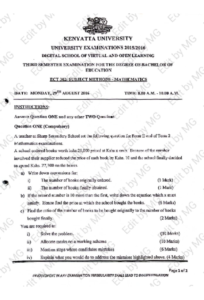
Past Paper on Mathematics Subject Methods For Revision
Above is the exam paper download link
Whether you are grappling with the “Spiral Approach” or trying to figure out how to teach Calculus to a distracted teenager, the theory can feel overwhelming. The most effective way to turn that theory into a teaching license is by practicing with past papers. To help you sharpen your pedagogical skills, we’ve put together a Q&A based on frequent exam themes, followed by a link to download a full revision paper.
Mathematics Methods: Key Revision Q&A
Q1: What is the difference between “Inductive” and “Deductive” reasoning in a Math classroom?
A: This is a staple question for any methods paper.
-
Inductive Reasoning starts with specific examples and leads to a general rule. For instance, you show students several right-angled triangles, let them measure the sides, and help them “discover” the Pythagorean theorem ($a^2 + b^2 = c^2$).
-
Deductive Reasoning starts with the general rule and moves to specific examples. You give them the theorem first, then show them how to apply it to find a missing side.
Q2: Why is the use of “Manipulatives” so emphasized in the primary and secondary syllabus?
A: Mathematics is an abstract language. Manipulatives—like blocks, geoboards, or even bottle caps—provide a concrete bridge to that abstraction. According to Bruner’s theory of representation, students learn best when they move from the Enactive (physical action) to the Iconic (images) and finally to the Symbolic (mathematical notation).
Q3: How do you handle “Math Anxiety” when planning a lesson?
A: An exam question on “Affective Domain” will look for strategies like:
-
Scaffolding: Breaking complex problems into smaller, achievable steps.
-
Relatability: Using real-life examples (e.g., calculating interest on a loan rather than just abstract percentages).
-
Positive Reinforcement: Focusing on the process of problem-solving rather than just the final answer.
Q4: What are the components of a ‘SMART’ objective in a Mathematics Lesson Plan?
A: Your objectives must be Specific, Measurable, Achievable, Relevant, and Time-bound. Instead of saying “Students will understand fractions,” a SMART objective would be: “By the end of the lesson, the learner should be able to add two proper fractions with different denominators correctly.”
Why You Should Practice with This Past Paper
Mathematics methods exams are unique because they often ask you to “Design a learning activity.” You can’t just memorize a definition; you have to create a mini-lesson on the fly. Here is why downloading the resource below is vital:
-
Master the Lesson Plan Format: Most papers have a heavy-mark question requiring you to draft a lesson plan or a work plan (Azimio la Kazi). Practicing this saves you time during the actual exam.
-
Identify Common Student Misconceptions: Examiners love to ask how you would correct a student who thinks $0.5 + 0.5 = 0.10$. Working through past papers prepares you for these “diagnostic” questions.
-
Understanding Bloom’s Taxonomy: You’ll learn how to write questions that test higher-order thinking (Analysis/Evaluation) rather than just simple recall.
Download Your Revision Resource
Ready to master the art of teaching? We have curated a high-standard Mathematics Subject Methods Past Paper that covers everything from instructional media to evaluation techniques.
[Download: Mathematics Subject Methods Revision Past Paper (PDF)]
(Pro-tip: When practicing, pay close attention to the ‘Schema of Work’ questions—they are often the difference between a ‘C’ and an ‘A’.)
Final Thoughts
Teaching mathematics is about more than just numbers; it’s about building logic and confidence in your students. Mastering the “Methods” is the first step toward being the teacher that students actually look forward to seeing. Download the paper, practice your lesson pacing, and walk into that exam room ready.
Back to Mpya News Home page: Education, Fashion, Law, business and sports
Last updated on: January 26, 2026
New information gained / new value takehome
- Mathematics Methods: Key Revision Q&A Q1: What is the difference between “Inductive” and “Deductive” reasoning in a Math classroom?
- ” Why You Should Practice with This Past Paper Mathematics methods exams are unique because they often ask you to “Design a learning activity.
- Back to Mpya News Home page: Education, Fashion, Law, business and sports Last updated on: January 26, 2026Mpya News Sitemap .
- News Education Rankings Reference 2: SNHU Distance Learning Reference 3: GCU University Programs Photo credit: instagram.
This content was developed using AI as part of our research process. To ensure absolute accuracy, all information has been rigorously fact-checked and validated by our human editor, Collins Murithi.