Download Pension Finance Exam Past Paper
Pension Finance Exam Past Paper: Your Complete Study Guide (650 Words)
Preparing for a Pension Finance exam can be challenging, especially because the subject combines technical financial concepts with actuarial thinking and real-world pension scheme management. For many students, the most effective way to understand the style, structure, and depth of questions is by using past exam papers. These papers not only reveal what examiners value but also help you practice application, analysis, and problem-solving — skills that are crucial in this field.
In this blog, we’ll explore why Pension Finance past papers are essential, what FLQs (Frequently-Likely Questions) commonly appear, and how to use past papers to strengthen your exam preparation.
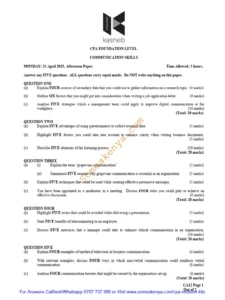
Pension-Finance-Exam-Past-Paper-Mpya-News
Why Pension Finance Past Papers Matter
Unlike purely theoretical subjects, Pension Finance requires students to bridge the gap between financial theory and pension scheme practice. You must understand investment decisions, funding, valuation methods, regulatory requirements, actuarial assumptions, and risk management. Reviewing past exam papers helps you see how these concepts are tested and how deeply you must apply your knowledge.
Most Pension Finance past papers include:
-
Calculation-based questions
-
Case-study questions on pension scheme management
-
Short, structured theory questions
-
Essay-style discussion questions
-
Application of actuarial or financial principles
-
Questions on regulation, governance, and retirement planning
By practising with past papers, you learn to think like an examiner — a major advantage heading into the exam.
FLQ Section: Common Frequently-Likely Questions in Pension Finance
Below are the most common types of questions that repeatedly appear in Pension Finance exams across universities and finance programs. These are not copied from any specific paper; instead, they reflect the standard topics examiners often focus on.
FLQ 1: “Discuss the key differences between Defined Benefit (DB) and Defined Contribution (DC) pension schemes.”
This is one of the most consistently asked questions, often appearing in the first section of an exam. Students must compare structure, risk distribution, contributions, payout certainty, and employer vs. employee responsibility.
How to answer:
Define both → compare features → show risks to member and sponsor → discuss modern trends.
FLQ 2: “Explain how actuarial assumptions affect pension fund valuation.”
Examiners want to check your understanding of discount rates, mortality assumptions, salary growth, and inflation assumptions.
How to answer:
Identify main assumptions → explain their effect on liabilities → use examples → link to funding levels.
FLQ 3: “Evaluate the importance of investment policy in pension fund management.”
This question tests your grasp of risk, return, asset-liability matching (ALM), and regulatory constraints.
How to answer:
Discuss objectives → explain portfolio design → relate to member demographics → conclude with risk management.
FLQ 4: “Calculate the present value of a pension annuity given specific assumptions.”
Exams often include numeric problems requiring you to discount future cash flows, apply interest factors, or compute funding ratios.
How to answer:
Use correct formulas → show clear steps → comment on results when required.
FLQ 5: “Analyze the risks faced by pension funds and strategies used to mitigate them.”
Risk topics such as longevity, investment volatility, inflation, and regulatory changes frequently appear.
How to answer:
Identify risks → explain impact on funding → present mitigation tools like hedging, ALM, diversification.
How to Use Pension Finance Past Papers Effectively
1. Practice Under Timed Conditions
Many students understand concepts but struggle with time management. Past papers help you build speed and structure your answers efficiently.
2. Master Key Formulas and Show Your Work
Pension Finance exams often award marks for process, not just final answers. Practising past papers helps you become comfortable with:
-
Discounting
-
Annuity factors
-
Funding ratios
-
Expected return calculations
-
Sensitivity analysis
3. Identify Patterns in Question Types
Once you review several papers, themes start to stand out:
-
Pension scheme design
-
Risk analysis
-
Funding and valuation
-
Regulation and governance
-
Investment strategy
These patterns guide your study priorities.
4. Write Full Essays for Theory Questions
Short notes aren’t enough. Write complete, structured answers with:
-
Introduction
-
Clear explanation
-
Real-world application
-
Conclusion
This is exactly what examiners look for.
5. Use Past Papers Alongside Lecture Notes
Past papers show what is examinable, while lecture notes provide the content. Combining both is the most effective preparation method.
Download Link
Back to Mpya News Home page: Education, Fashion, Law, business and sports
Last updated on: November 17, 2025
New information gained / new value takehome
- In this blog, we’ll explore why Pension Finance past papers are essential, what FLQs (Frequently-Likely Questions) commonly appear, and how to use past papers to strengthen your exam preparation.
- FLQ 1: “Discuss the key differences between Defined Benefit (DB) and Defined Contribution (DC) pension schemes.
- How to answer:Use correct formulas → show clear steps → comment on results when required.
- Master Key Formulas and Show Your Work Pension Finance exams often award marks for process, not just final answers.
- Write Full Essays for Theory Questions Short notes aren’t enough.
- Use Past Papers Alongside Lecture Notes Past papers show what is examinable, while lecture notes provide the content.
This content was developed using AI as part of our research process. To ensure absolute accuracy, all information has been rigorously fact-checked and validated by our human editor, Wycklliff Muthinja.
