Understanding the sounds of human speech is the foundation of linguistics. The Introduction to Phonetics and Phonology course covers the essential principles of how speech sounds are produced, transmitted, and organized in language systems. Having access to past examination papers is crucial for effective preparation. This guide provides you with official and reliable sources to download authentic past papers in PDF format and answers the most frequently asked questions about the subject.
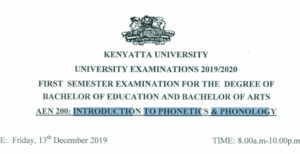
Below is the PDF Link for Introduction to Phonetics & Phonology
Past Paper on Introduction to Phonetics & Phonology
Above is the PDF link for Introduction to Phonetics & Phonology
Where to Download Introduction to Phonetics & Phonology Past Papers
To ensure you are practicing with genuine, reliable past exam papers, always use official university repositories and academic websites. Here are the best verified sources:
-
Institutional Repositories: Many universities host past examination papers in their institutional repositories, which are available for public access. For example, Alupe University provides PDF downloads of past papers for courses such as KIS 211: Phonetics and Phonology, stored in their repository.
-
Academic Exam Platforms: Some educational platforms collect and share past exam questions from various universities. For instance, KU Mombasa past papers for the course BLA2103: Introduction to Phonetics and Phonology are available on such platforms, offering direct PDF downloads.
-
University Past Paper Databases: Several universities have dedicated portals for past exam papers. You can often find PDFs by searching a university’s library or exam department website. Examples include past papers from the University of the West Indies (Course LING 1001), Elizade University (Course ENG 201), Gulu University (Course ENG 2102), and the University of Swaziland.
-
Academic E-Print Repositories: Some institutions use systems like EPrints to store and provide access to academic materials, including past year exam papers. For example, one such repository from UPTM provides a PDF for a Phonetics and Phonology exam.

Important Note: When downloading past papers, always verify they are from an official or reputable source. The content of lectures and exams can change, so ensure the paper you are using aligns with your current syllabus and academic year.
Frequently Asked Questions (FAQs) About Phonetics and Phonology Past Papers
Here are some of the most common questions students have when preparing for their exams in this subject.
1. What are the major topics covered in Phonetics and Phonology exams?
Based on past papers, the exams typically cover a broad range of topics. These include:
-
The Three Main Branches of Phonetics: Articulatory, Acoustic, and Auditory phonetics.
-
The International Phonetic Alphabet (IPA): Transcribing words using IPA symbols is a common practical task. This often includes identifying symbols for specific vowel and consonant sounds in given words.
-
Describing Speech Sounds: You are expected to classify consonant sounds by their place and manner of articulation and vowels using criteria like height, backness, and lip rounding.
-
Phonological Concepts: Defining and differentiating core terms such as phoneme, phone, allophone, and understanding concepts like minimal pairs, syllable structure, and phonological processes.
-
The Relationship Between Phonetics and Phonology: This is a frequently examined theoretical question, where you must compare and contrast the two fields.

2. What are the key differences between Phonetics and Phonology?
Phonetics is the physical study of speech sounds—how they are produced (articulatory), transmitted (acoustic), and perceived (auditory). Phonology, on the other hand, is the abstract study of how these sounds are organized and function within a specific language to create meaning. For example, phonetics explains how a sound is physically made, while phonology explains why substituting one sound for another can change the meaning of a word (like “cat” vs “bat”).
3. What are the different types of phonetic transcriptions I might see?
Past papers often test your ability to use phonetic transcription. The two most common types are:
-
Broad Transcription (Phonemic) : This uses a simplified set of symbols, typically enclosed in slashes / /, to represent the abstract phonemes of a language. It does not capture all phonetic details. For example, the word ‘pin’ is transcribed as /pɪn/.
-
Narrow Transcription (Phonetic) : This uses a more detailed set of symbols, enclosed in square brackets [ ], to represent the exact pronunciation. It can include diacritics to show features like aspiration. For example, the aspirated ‘p’ in ‘pin’ can be transcribed as [pʰɪn].
4. How can I effectively use past papers to study?
Using past papers is a proven revision strategy. Here are a few tips:

-
Simulate Exam Conditions: Set a timer and attempt the paper without your notes. This helps you practice time management and identify areas where you struggle.
-
Check Your Answers: Use your textbooks, lecture notes, and reliable online resources to verify your answers, especially for IPA transcriptions. The exact transcriptions can be a point of difficulty, and practicing with policy-page-at-mpya-news/" title="Feedback">feedback is key.
-
Identify Recurring Themes: Look through several years of past papers to see which topics, such as the classification of consonants and vowels, appear repeatedly. This helps you prioritize your study efforts.
Back to Mpya News Home page: Education, Fashion, Law, business and sports
Last updated on: August 11, 2026
New information gained / new value takehome
- The Introduction to Phonetics and Phonology course covers the essential principles of how speech sounds are produced, transmitted, and organized in language systems.
- Important Note: When downloading past papers, always verify they are from an official or reputable source.
- The content of lectures and exams can change, so ensure the paper you are using aligns with your current syllabus and academic year.
- What are the key differences between Phonetics and Phonology?
- Here are a few tips: Simulate Exam Conditions: Set a timer and attempt the paper without your notes.
- Check Your Answers: Use your textbooks, lecture notes, and reliable online resources to verify your answers, especially for IPA transcriptions.
- The exact transcriptions can be a point of difficulty, and practicing with feedback is key.
This content was developed using AI as part of our research process. To ensure absolute accuracy, all information has been rigorously fact-checked and validated by our human editor, Alex Munene.
External resource 1: Google Scholar Academic Papers
External resource 2: Khan Academy Test Prep
Reference 1: KNEC National Examinations
Reference 2: JSTOR Academic Archive
Reference 3: Shulefiti Revision Materials
Photo credit: instagram.com
