If you are looking for the Next of Kin Form for Meru County, it is important to first identify which institution or service requires the form. A next-of-kin form is generally used to record the person or people who should be contacted or recognized in relation to an employee or member, particularly in circumstances involving death, emergencies, employment benefits or other official matters.
Below is the download link for Next of Kin Form Meru County
Above is the download link for Next of Kin Form Meru County
For employees of the County Government of Meru, next-of-kin information is included in official employee records. A Meru County Government employee verification document, for example, contains fields for the next of kin’s full name, relationship and mobile number, followed by a declaration that the information provided is accurate.
What Is a Next of Kin Form?
A Next of Kin Form is an official document used to provide details of a person’s nominated family member or other appropriate contact.
Depending on the institution, the form may request information such as:
- Full name of the next of kin
- Relationship to the applicant or employee
- National ID number
- Telephone/mobile number
- Postal or physical address
- Alternative next-of-kin details
- Signature and date
The exact fields differ between organizations. For example, the national Government Printers G.P. 25 Next-of-Kin Form asks for particulars of the officer and the primary and alternative next of kin.
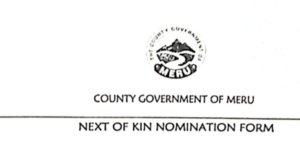
Download the Meru County Next of Kin Form
If you have been instructed by the Meru County Government to complete a next-of-kin form, use the version supplied by your department, Human Resource office or the relevant county office rather than downloading an unrelated form from another institution.
This distinction is important because Kenya has several different next-of-kin forms. For example, the Teachers Service Commission has its own Teachers Next-of-Kin Form, while the Ministry of Health provides the Government Printers G.P. 25 form for officers.
Important: A general next-of-kin form should not automatically be treated as an official Meru County form unless it has been issued or accepted by the relevant Meru County department.
Information Required on a Next of Kin Form
Before filling out the form, have the following information available:
1. Your personal details
You may be required to provide your full name, identification number, employee number, department or other employment details.
2. Next of kin’s full name
Write the person’s full legal name as it appears on their identification documents.
3. Relationship
Clearly indicate the relationship, such as:

- Spouse
- Parent
- Son
- Daughter
- Brother
- Sister
- Other recognized relative
The relationship requirements can vary depending on the institution.
4. Contact information
Provide a current telephone number and, where requested, a physical or postal address. Keeping these details updated is particularly important because the next of kin may need to be contacted during an emergency.
5. Declaration and signature
Read the declaration carefully before signing. Some official forms require the applicant or employee to confirm that the information supplied is accurate.
Why Is a Next of Kin Form Important?
A properly completed next-of-kin record helps an organization identify an appropriate contact when necessary.
For employees, it can also form part of employment records and may be relevant when an employer is handling matters following an employee’s death. The specific legal effect of a nomination, however, depends on the applicable law, employment terms, benefit scheme and the particular form being completed.
It is therefore important not to assume that naming someone as “next of kin” automatically makes that person the beneficiary of every asset or estate belonging to you.
How to Fill Out the Form
Follow these steps:
Step 1: Obtain the correct form.
Get the form from the Meru County department, Human Resource office or institution that requested it.
Step 2: Enter your personal information.
Use your official names and identification details.
Step 3: Enter the next of kin’s information.
Provide accurate names, relationship and contact details.
Step 4: Check the information.
Confirm that telephone numbers, names and identification details are correct.
Step 5: Sign and date the form.
Do not leave the declaration section incomplete if a signature is required.
Step 6: Submit it to the relevant office.
Follow the instructions given by your employer or the department handling the form.
Can I Use a TSC Next-of-Kin Form for Meru County?
Not necessarily.
The Teachers Service Commission (TSC) has a specific Teachers Next-of-Kin Form containing fields for a teacher’s TSC number, ID number, appointment information, address and nominated next of kin.
If you are a teacher employed by TSC and you have been asked to submit a next-of-kin form, the TSC form is the appropriate document rather than a generic Meru County form.
Does a Next of Kin Have to Be a Family Member?
Usually, the person named should have a recognized personal relationship with you, but the requirements depend on the organization and purpose of the form.
For example, the TSC form describes relationships such as husband, wife, son, daughter, father and mother.
Always follow the instructions printed on the particular form you have been given.
Can I Change My Next of Kin?
In many employment and membership systems, next-of-kin information can be updated when circumstances change. For example, the TSC’s official form instructs teachers to communicate subsequent changes to their records immediately.
If you work for Meru County Government, contact your Human Resource office or the relevant county department to establish the procedure for changing your records.
What Happens If the Information Is Wrong?
Incorrect contact information can make it difficult for an organization to reach the person you have nominated.
Before submitting the form, check:
- Spelling of names
- Telephone numbers
- Relationship
- ID numbers, where required
- Address
- Signature and date
It is also advisable to notify the relevant office whenever important details change.
Is a Next of Kin the Same as a Beneficiary?
No, not necessarily.
A next of kin is generally a person identified through a family or personal relationship and may serve as an important contact. A beneficiary is a person legally entitled to receive a particular benefit, asset or payment under the relevant arrangement.
The two roles can overlap, but being listed as next of kin does not automatically mean that someone is entitled to all of your property or benefits.
Questions concerning inheritance and administration of an estate should be handled according to the applicable Kenyan succession laws and procedures.
Frequently Asked Questions
1. Where can I get the Meru County Next of Kin Form?
If the form is required for employment with Meru County Government, the safest option is to obtain the current version from the relevant county Human Resource office or department. Meru County’s official employee documentation confirms that next-of-kin details form part of employee information.
2. Is there only one Next of Kin Form in Kenya?
No. Different government institutions and organizations use different forms. TSC, for example, has its own Teachers Next-of-Kin Form, while G.P. 25 is another government next-of-kin form.
3. What details are normally required?
Common details include the next of kin’s full name, relationship, telephone number and address. Some forms additionally require an ID number, age or alternative next-of-kin information.
4. Can I name more than one next of kin?
This depends on the particular form. Some forms provide space for multiple nominees, while others ask for a primary next of kin and an alternative contact.

5. Can I nominate my spouse as my next of kin?
A spouse is commonly recognized as a next-of-kin relationship on Kenyan institutional forms, but you should follow the specific requirements of the organization requesting the form.
6. Can I nominate my parent?
Yes, where the relevant institution permits it. Parents are among the relationships expressly listed in the TSC’s official next-of-kin form.
7. Does the next of kin automatically inherit my property?
No. Being listed as next of kin should not be confused with automatically inheriting a person’s entire estate. Inheritance is governed by applicable succession law and other relevant legal arrangements.
8. Can I change my next of kin later?
In many organizations, yes. You should contact the relevant Human Resource or administration office and follow its procedure for updating personal records.
9. Is the next-of-kin form the same as an affidavit of next of kin?
No. An institutional next-of-kin form is generally used to record nominated contacts or dependants, while an affidavit of next of kin is a separate legal document used for particular legal purposes.
10. What should I do if I cannot find the official Meru County form online?
Contact the Meru County Government office or the department that requested the form. This is preferable to downloading a form belonging to another organization and assuming that it will be accepted.
Back to Mpya News Home page: Education, Fashion, Law, business and sports
Last updated on: August 18, 2026
New information gained / new value takehome
- If you are looking for the Next of Kin Form for Meru County, it is important to first identify which institution or service requires the form.
- This distinction is important because Kenya has several different next-of-kin forms.
- Important: A general next-of-kin form should not automatically be treated as an official Meru County form unless it has been issued or accepted by the relevant Meru County department.
- Keeping these details updated is particularly important because the next of kin may need to be contacted during an emergency.
- The specific legal effect of a nomination, however, depends on the applicable law, employment terms, benefit scheme and the particular form being completed.
- It is therefore important not to assume that naming someone as “next of kin” automatically makes that person the beneficiary of every asset or estate belonging to you.
- A next of kin is generally a person identified through a family or personal relationship and may serve as an important contact.
- A beneficiary is a person legally entitled to receive a particular benefit, asset or payment under the relevant arrangement.
- The two roles can overlap, but being listed as next of kin does not automatically mean that someone is entitled to all of your property or benefits.
- Some forms provide space for multiple nominees, while others ask for a primary next of kin and an alternative contact.
This content was developed using AI as part of our research process. To ensure absolute accuracy, all information has been rigorously fact-checked and validated by our human editor, Alex Munene.