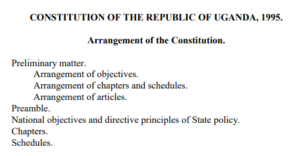
The Constitution of the Republic of Uganda, 1995, as amended, stands as the supreme law of the land, forming the bedrock of governance and the legal system. Promulgated on October 8, 1995, it ushered in a new era after years of political turmoil, establishing a framework for democratic governance, human rights protection, and national unity .
Below is the download link for the Constitution of Uganda
Most recent Constitution of the Republic of Uganda
Above is the download link for the Constitution of Uganda
Whether you are a student, legal professional, civil servant, or a citizen seeking to understand your rights, having access to the official, up-to-date PDF is essential. This guide provides all the information you need to download the authentic document, plus answers to the most frequently asked questions.
Where to Download the Official Constitution of Uganda PDF
To ensure you have the genuine and legally accurate version that includes all amendments, always download from official government sources or reputable legal repositories. The authoritative version is published by the Parliament of Uganda .
Here are the most reliable sources for a secure download:
-
Parliament of Uganda Website: This is the primary source for legal documents originating from the legislature. The official parliamentary gateway provides PDF copies of the Constitution and its amending acts.
-
Uganda Legal Information Institute (ULII): ULII provides a freely accessible, updated, and consolidated version of the Constitution, which is an excellent resource for legal research.
-
Embassy of the Republic of Uganda: The official government website often links to the Constitution, affirming its status as an official document.
-
Refworld: A reputable source for legal and refugee information, providing a consolidated version of the Constitution as amended up to 2017.
File Format: The document is typically a PDF file. The legislative content is public and free for anyone to download and use for personal, academic, or professional purposes.

Important Note: Always verify you are downloading the most recent “consolidated” version that incorporates all amendments. The 1995 Constitution has been amended multiple times, most notably in 2005 and 2015 . An outdated version may not reflect the current law.
Frequently Asked Questions (FAQs) About the 1995 Constitution
Here are some of the most common questions Ugandans and researchers have about the Constitution.
1. What are the key features of the 1995 Constitution?
The 1995 Constitution fundamentally restructured the Ugandan state. Its key features include:
-
The Supremacy Clause (Article 2): It declares the Constitution the supreme law of Uganda, meaning any other law inconsistent with it is void to the extent of the inconsistency .
-
The Bill of Rights (Chapter Four): It guarantees fundamental rights and freedoms for all persons, which are justiciable, meaning citizens can enforce them in courts of law .
-
The Executive (Chapter Seven): It establishes the President as the Head of State, Head of Government, and Commander-in-Chief of the armed forces, with a defined term of office.
-
The Legislature (Chapter Six): It establishes a Parliament consisting of the President and the National Assembly, with powers to make laws for the peace, order, and good government of Uganda.
-
The Judiciary (Chapter Eight): It establishes an independent judiciary, with the Supreme Court as the highest court of appeal.
-
The Electoral Commission (Article 61): The Constitution establishes an independent Electoral Commission to ensure regular, free, and fair elections and to administer referendums.
2. Has the 1995 Constitution been amended? If so, how many times?
Yes, the Constitution has been amended several times. At least 65 original Articles have been amended since its promulgation. These amendments have been carried out under several acts, including:
-
The Constitution (Amendment) Act, 2000
-
The Constitutional (Amendment) Act, 2005
-
The Constitutional (Amendment) (No.2) Act, 2005
-
The Constitutional (Amendment) Act, 2015

The significant number of amendments has led some legal experts, like Professor Frederick Ssempebwa, to call for a total review of the Constitution .
3. What is the process for amending the Constitution?
The Constitution provides a rigorous amendment process to protect its core principles. Chapter Eighteen outlines the procedure :
-
Amendments by Parliament (Article 262): A bill to amend most provisions of the Constitution must be supported at the second and third readings by the votes of not less than two-thirds of all members of Parliament .
-
Amendments Requiring a Referendum (Article 260): Certain amendments, particularly those affecting foundational principles like the term of office of the President, require a national referendum and must also be ratified by a majority of district councils .
4. Is the Constitution available in other languages?
While English is the authoritative language for legal proceedings, the Constitution has been translated into other languages to enhance public understanding. Efforts have been made to ensure accessibility for all citizens, though the official record remains in English.
5. What is the role of the Electoral Commission under the Constitution?
The Electoral Commission, established under Article 61, has several crucial functions :
-
Ensuring regular, free, and fair elections and referendums
-
Demarcating constituencies
-
Ascertaining, publishing, and declaring election results
-
Compiling, maintaining, and updating the voters’ register
-
Hearing and determining election complaints arising before and during polling
-
Formulating and implementing civic education programs related to elections

6. Does the Constitution provide for referendums?
Yes. The Constitution allows for referendums on national issues. The Referendum and Other Provisions Act (2005) provides the detailed framework for citizens to demand a referendum through a petition, as well as for government-initiated referendums . Certain constitutional amendments also require a referendum
Back to Mpya News Home page: Education, Fashion, Law, business and sports
Last updated on: August 11, 2026
New information gained / new value takehome
- Promulgated on October 8, 1995, it ushered in a new era after years of political turmoil, establishing a framework for democratic governance, human rights protection, and national unity .
- Important Note: Always verify you are downloading the most recent “consolidated” version that incorporates all amendments.
- The 1995 Constitution has been amended multiple times, most notably in 2005 and 2015 .
- What are the key features of the 1995 Constitution?
- The Electoral Commission (Article 61): The Constitution establishes an independent Electoral Commission to ensure regular, free, and fair elections and to administer referendums.
- Efforts have been made to ensure accessibility for all citizens, though the official record remains in English.
This content was developed using AI as part of our research process. To ensure absolute accuracy, all information has been rigorously fact-checked and validated by our human editor, Alex Munene.