If you’ve ever changed the way you talk because you were in a job interview rather than at a bar with friends, you were practicing Sociolinguistics. This field is the fascinating study of how language interacts with society—how our class, gender, ethnicity, and even our location dictate the “version” of a language we use.
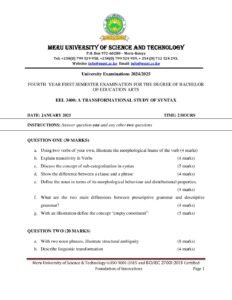
Below is the exam paper download link
Past Paper On Sociolinguistics For Revision
Above is the exam paper download link
Unlike formal grammar, which focuses on “the rules,” sociolinguistics focuses on “the reality.” It’s messy, it’s political, and it’s constantly shifting. For a student, this means the exams aren’t just about memorizing definitions; they are about analyzing social power dynamics through the lens of speech.
The best way to stop feeling like the theory is just “common sense” and start treating it like a science is to practice with past papers. To help you prep, we’ve tackled some of the biggest questions found in previous years, followed by a link to download a full revision paper.
Decoding Society: Sociolinguistics Q&A
Q1: What is “Diglossia” and how does it differ from standard bilingualism?
A: This is a staple in sociolinguistics papers. Diglossia occurs in a society where two varieties of the same language are used under different conditions. There is usually a “High” variety (H) used for literature, education, and government, and a “Low” variety (L) used for everyday conversation. Think of Classical Arabic versus the local dialects. In an exam, emphasize that unlike bilingualism, these two varieties have strictly defined social functions.

Q2: Why do people “Code-switch” and what does it reveal about their identity?
A: Code-switching is the practice of alternating between two or more languages or varieties in a single conversation. It’s rarely random. People switch to show solidarity with a group, to exclude others, or to signal authority. If an exam asks you to analyze a transcript, look for the trigger—did the topic change, or did a new person enter the room?
Q3: Explain the difference between “Language” and “Dialect” from a sociolinguistic perspective.
A: This is a trick question! Linguistically, there isn’t much difference. But sociolinguistically, “a language is a dialect with an army and a navy.” The distinction is usually about Prestige and Power. Standard English is just the dialect that happened to be used by those in power. In your revision, be ready to discuss “Mutual Intelligibility” versus “Political Legitimacy.”
Q4: What are “Language Attitudes” and why do they matter for policy makers?
A: This refers to the feelings or prejudices people have toward certain dialects or languages. For example, some people might incorrectly view a certain accent as “uneducated.” Examiners want to see that you understand how these attitudes can lead to linguistic discrimination in schools or the workplace.
Why You Should Practice with This Past Paper
Sociolinguistics exams often use “Scenario-based” questions. You might be given a description of a small island with three different languages and asked to predict what will happen to them over fifty years. Here is why the download below is essential:
-
Mastering the Terminology: Can you distinguish between a Pidgin and a Creole? Or Language Shift versus Language Death? Past papers ensure you use these terms with surgical precision.
-
Analyzing Variation: You’ll learn how to interpret William Labov’s famous studies on social stratification. Being able to explain why New Yorkers drop the “r” sound depending on their department store of choice is a high-mark skill.
-
Global Perspectives: Many papers focus on the spread of “World Englishes.” Practicing helps you argue the merits of Kenyan English or Indian English as valid varieties rather than “errors.”


Your Free Revision Resource
Ready to stop guessing and start analyzing? We have curated a comprehensive Sociolinguistics Past Paper to help you test your understanding of language and social identity.
[Download: Sociolinguistics Revision Past Paper (PDF)]
(Pro-tip: When revising, pay close attention to the “Gender and Language” section. Modern papers are moving away from the old “Difference vs. Dominance” models and looking more at “Performative” identity. Keep your answers updated with current research!)


Final Thoughts
Sociolinguistics proves that language is never neutral; it is a tool for connection and a weapon of exclusion. By mastering these papers, you are learning to read between the lines of every conversation. Download the paper, grab your highlighters, and start your revision journey.
Back to Mpya News Home page: Education, Fashion, Law, business and sports
Last updated on: January 29, 2026
New information gained / new value takehome
- If you’ve ever changed the way you talk because you were in a job interview rather than at a bar with friends, you were practicing Sociolinguistics.
- If an exam asks you to analyze a transcript, look for the trigger—did the topic change, or did a new person enter the room?
- Here is why the download below is essential: Mastering the Terminology: Can you distinguish between a Pidgin and a Creole?
- Past papers ensure you use these terms with surgical precision.
- Being able to explain why New Yorkers drop the “r” sound depending on their department store of choice is a high-mark skill.
- [Download: Sociolinguistics Revision Past Paper (PDF)] (Pro-tip: When revising, pay close attention to the “Gender and Language” section.
- Back to Mpya News Home page: Education, Fashion, Law, business and sports Last updated on: January 29, 2026Mpya News Sitemap .
- News Education Rankings Reference 2: SNHU Distance Learning Reference 3: GCU University Programs Photo credit: instagram.
This content was developed using AI as part of our research process. To ensure absolute accuracy, all information has been rigorously fact-checked and validated by our human editor, Collins Murithi.

