Let’s be honest: when most people hear the words “Technology Education,” they picture a room full of students typing on keyboards or maybe 3D printing a plastic trinket. But for those of us in the field, we know the truth—it is the study of human ingenuity. It’s about how we identify problems and build the tools to solve them.
Below is the exam paper download link
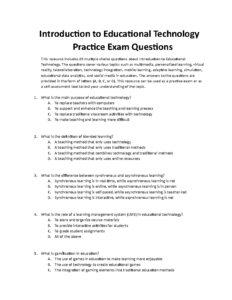
Past Paper On Introduction To Technology Education For Revision
Above is the exam paper download link
If you are preparing for an introductory exam in this subject, you are standing at the intersection of science, art, and policy-page-at-mpya-news/" title="Ethics">ethics. You aren’t just learning how to use gadgets; you are learning the Technological Method. To help you shift your perspective from “user” to “innovator,” we’ve tackled the foundational questions that frequently anchor the grading curve in past papers.
The Revision Q&A: Building the Technological Mindset
Q: What is the core difference between ‘Educational Technology’ and ‘Technology Education’? This is the classic “Gotcha” question in many intro papers.
-
Educational Technology (EdTech): Is using technology to teach (think iPads in classrooms or Zoom lectures).
-
Technology Education: Is learning about technology—its history, its systems, and how to design it. In your exam, if you’re asked about the “subject area,” you are talking about the latter. It’s a distinct academic discipline focused on Technological Literacy.
Q: How do I explain the ‘Design Process’ without missing a step? Think of the Design Process as the “Scientific Method” for builders. It’s iterative, meaning you go back and forth. The standard steps found in past papers usually include:
-
Identifying a Need: What’s the problem?
-
Research: What already exists?
-
Ideation: Brainstorming solutions.
-
Prototyping: Building a “rough draft.”
-
Testing and Evaluation: Does it work?
When answering, always emphasize that failure in the “Testing” phase is actually a success because it leads to a better “Improvement” phase.
Q: What are the ‘Seven Technological Systems’? Planners and examiners love to categorize. Technology isn’t just a monolith; it’s divided into systems: Communication, Construction, Manufacturing, Energy/Power, Transportation, Medical, and Agriculture/Biotechnology. If a question asks you to analyze the impact of technology on society, try to pick one of these systems to provide specific examples.
Q: Why is ‘Technological Assessment’ becoming a high-point topic? In 2026, we don’t just ask “Can we build it?” We ask “Should we build it?” Technological Assessment is about looking at the unintended consequences of an invention—like how social media impacted mental health or how plastic changed the ocean. Mentioning the “trade-offs” between efficiency and ethics is a surefire way to get into the top marks bracket.
The Power of the Past Paper: Your Blueprint for Success
You can read about “Input-Process-Output” models for days, but Technology Education is a practical, logical discipline. You need to know how to draw a System Diagram or justify a material choice under a 45-minute timer.

By downloading our Introduction to Technology Education past paper, you will:
-
Master the Jargon: Practice using terms like Feedback Loops, Sub-systems, Constraints, and Optimization.
-
Refine Your Logic: Learn how to break a complex problem down into manageable parts—a key skill for any design-based question.
-
Identify Trends: You’ll notice that questions on Sustainable Design and Artificial Intelligence are now standard in introductory papers.
Download Your Revision Material Here
Ready to move from a consumer to a creator? Don’t leave your grades to the “luck of the draw.” The best way to build your confidence is to tackle the design and systems puzzles that have challenged students for years. Use the link below to download a curated past paper on Introduction to Technology Education.
[Click Here to Download the Introduction to Technology Education Past Paper]
A Quick Parting Tip: The ‘Black Box’ Concept
If you see the term “Black Box” in a paper, don’t panic. It just refers to a system where you know the Input and the Output, but you don’t necessarily need to know the complex internal Process. Using this analogy in an essay about “User-Centered Design” shows the marker you have a sophisticated grasp of system theory!
Back to Mpya News Home page: Education, Fashion, Law, business and sports
Last updated on: February 4, 2026
New information gained / new value takehome
- Let’s be honest: when most people hear the words “Technology Education,” they picture a room full of students typing on keyboards or maybe 3D printing a plastic trinket.
- When answering, always emphasize that failure in the “Testing” phase is actually a success because it leads to a better “Improvement” phase.
- Refine Your Logic: Learn how to break a complex problem down into manageable parts—a key skill for any design-based question.
- Back to Mpya News Home page: Education, Fashion, Law, business and sports Last updated on: February 4, 2026Mpya News Sitemap .
- News Education Rankings Reference 2: SNHU Distance Learning Reference 3: GCU University Programs Photo credit: instagram.
This content was developed using AI as part of our research process. To ensure absolute accuracy, all information has been rigorously fact-checked and validated by our human editor, Collins Murithi.