Let’s be honest: most people think fitness is just about “eating clean” and “training hard.” But if you’re sitting for an exam in Exercise Physiology and Sports Nutrition, you know it’s far more scientific than that. You aren’t just looking at a plate of pasta; you’re looking at a Glycemic Index calculation. You aren’t just breathing hard; you’re experiencing an Oxygen Deficit.
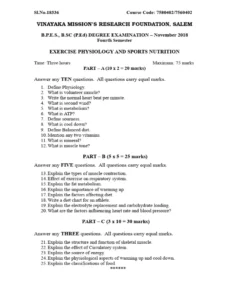
Below is the exam paper download link
Past Paper On Exercise Physiology And Sports Nutrition For Revision
Above is the exam paper download link
This subject is the “engine room” of sports science. It explains how the body converts a sandwich into a sprint and how the lungs adapt to thin mountain air. To help you stop staring at your textbook in a daze, we’ve tackled the big “high-yield” questions that consistently show up in recent past papers.
The Revision Q&A: Fueling the Human Machine
Q: What are the three energy systems and when do they “take the lead”? This is the most common “Question One” in the book. Your body doesn’t just use one fuel tank; it has three:
-
ATP-PC System: For explosive power (0–10 seconds), like a 100m sprint. It uses stored phosphates.
-
Anaerobic Glycolytic System: For high intensity (10 seconds to 2 minutes), like a 400m run. It produces lactic acid.
-
Aerobic System: For long duration (over 2 minutes), like a marathon. It uses oxygen to burn fats and carbs.
Q: Why do marathon runners “hit the wall” (bonking)? In a nutrition paper, this is all about Glycogen Depletion. Your body can only store a limited amount of carbohydrates in the liver and muscles. Once those are gone, the body tries to burn fat, which is a much slower process. To answer this like a pro, mention that Carbohydrate Loading 48 hours before a race is designed to maximize these stores.
Q: What is VO2 Max and why is it the “Gold Standard” of fitness? VO2 Max is the maximum amount of oxygen your body can use during intense exercise. It measures the efficiency of your heart, lungs, and blood. In an exam, if you are asked how to improve it, focus on Interval Training (HIIT), which forces the cardiovascular system to adapt to higher demands.
Q: What is the ‘Glycemic Index’ (GI) and how should an athlete use it? Not all carbs are created equal.
-
High GI foods (like white bread) spike blood sugar quickly—perfect for during or immediately after a workout.
-
Low GI foods (like oats) release energy slowly—perfect for a pre-game meal 3 hours before the whistle blows.
The Power of the Past Paper: Your Physiological Roadmap
You can read about the “Krebs Cycle” until your eyes glaze over, but Exercise Physiology is a technical craft. You need to know how to interpret a Lactate Threshold graph or justify a Macro-nutrient ratio for a rugby player versus a gymnast.
By downloading our Exercise Physiology and Sports Nutrition past paper, you will:
-
Master the Calculations: Practice calculating BMR (Basal Metabolic Rate) and sweat rates so you don’t fumble the numbers in the exam hall.
-
Refine Your Logic: Learn how to link a specific nutrient (like Protein) to a specific physiological process (like Muscle Protein Synthesis/MPS).
-
Identify Trends: You’ll notice that questions on Hydration Electrolytes and Intermittent Fasting effects on performance are trending in 2026 papers.
Download Your Revision Material Here
Ready to move from a gym-goer to a sports scientist? Don’t leave your grades to the “bro-science” you hear in the locker room. The best way to build your confidence is to tackle the biochemical puzzles that have challenged students for years. Use the link below to download a curated past paper.
[Click Here to Download the Exercise Physiology and Sports Nutrition Past Paper]
A Quick Parting Tip: The ‘EPOC’ Rule
Whenever you’re asked about recovery, always mention EPOC (Excess Post-exercise Oxygen Consumption). This is why you keep breathing hard even after you stop running. Your body is “paying back” the oxygen debt to clear lactic acid and restore ATP. Mentioning this “afterburn effect” is a surefire way to impress your marker!
Last updated on: February 5, 2026