Let’s be honest: Critical Thinking and Logic is the only subject that teaches you how to think rather than what to think. It’s the “operating system” for your brain. While other subjects give you data, this one gives you the filters to figure out if that data is actually true, misleading, or just plain nonsense.
Below is the exam paper download link
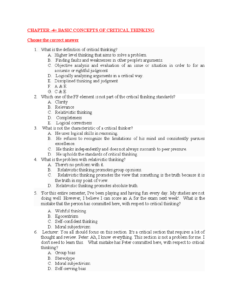
Past Paper On Critical Thinking And Logic For Revision
Above is the exam paper download link
When you sit down for a Logic exam, you aren’t just memorizing facts; you are solving puzzles. You are looking for the “glitch in the matrix”—that moment where an argument sounds good but falls apart under the cold light of a truth table. To help you sharpen your mental scalpel, we’ve tackled the big “brain-twisters” found in recent past papers.
The Revision Q&A: Deconstructing the Art of Reason
Q: What is the difference between a ‘Deductive’ and an ‘Inductive’ argument?
This is the cornerstone of any Logic paper.
-
Deductive Reasoning: This is about “certainty.” If the premises are true, the conclusion must be true. (e.g., All men are mortal; Socrates is a man; therefore, Socrates is mortal.)
-
Inductive Reasoning: This is about “probability.” You observe patterns and make a generalized guess. (e.g., Every crow I’ve seen is black; therefore, all crows are probably black.)
In an exam, if a question asks about the “strength” of an argument, they are usually talking about Induction. If they ask about “validity,” they are talking about Deduction.
Q: How do I spot a ‘Straw Man’ fallacy in a text?
The “Straw Man” is the favorite tool of dishonest debaters. It happens when someone takes your argument, oversimplifies it into a ridiculous version (the “straw man”), and then attacks that version instead of what you actually said.
Example: > You: “I think we should invest more in public libraries.”
Opponent: “So you want to bankrupt the police department to buy more comic books?”
When you see an extreme exaggeration in a past paper scenario, you’ve likely found a Straw Man.
Q: What is a ‘Syllogism’ and how do Venn Diagrams help?
A syllogism is a three-part logical argument. To check if one is valid, we use Venn Diagrams to visualize the relationships between groups. If the circles don’t overlap in the way the conclusion claims, the argument is “invalid.”
Q: Why are ‘Cognitive Biases’ the enemies of Critical Thinking?
Logic is the math, but Biases are the “bugs” in our biological software.
-
Confirmation Bias: Only looking for info that proves you’re right.
-
Ad Hominem: Attacking the person’s character instead of their argument.
In your revision, practice identifying these in news snippets or social media posts—it’s exactly how examiners structure their multiple-choice questions.
The Power of the Past Paper: Your Logical Roadmap
You can read about “Socratic Questioning” until you’re blue in the face, but Logic is a performance art. You won’t know if you’ve truly mastered Formal Logic or Propositional Calculus until you try to translate a complex sentence into symbols under a 45-minute timer.
By downloading our Critical Thinking and Logic past paper, you will:
-
Master Symbolization: Practice turning “If it rains, then the ground is wet” into $P \rightarrow Q$.
-
Refine Your Fallacy Detection: Learn to distinguish between a Post Hoc fallacy (it happened after, so it was caused by) and a simple correlation.
-
Spot the Trends: You’ll notice that questions on AI policy-page-at-mpya-news/" title="Ethics">Ethics and Algorithmic Bias are becoming standard features in 2026.
Download Your Revision Material Here
Ready to turn your “gut feelings” into “logical certainties”? Don’t leave your grades to the mercy of a weak argument. The best way to build your confidence is to tackle the structural puzzles that have challenged philosophers for centuries. Use the link below to download a curated past paper.
[Click Here to Download the Critical Thinking and Logic Past Paper PDF]
A Quick Parting Tip: The ‘Occam’s Razor’ Rule
Whenever you are faced with two competing explanations in a logic problem, remember Occam’s Razor: The simplest explanation that fits all the facts is usually the right one. Don’t go looking for complex conspiracies when a simple error in judgment explains the situation better. Mentioning this principle in your long-form answers is an easy way to show “critical depth!”
Last updated on: February 6, 2026