Semantics—the study of meaning in language—is a core subject in linguistics that examines how words, phrases, and sentences convey meaning. Whether you’re preparing for exams or simply want to deepen your understanding, practising with past papers is one of the most effective revision strategies. This guide provides a curated list of authentic past examination papers in PDF format and answers frequently asked questions to help you focus your studies.
BELOW IS THE EXAM PAPER DOWNLOAD LINK
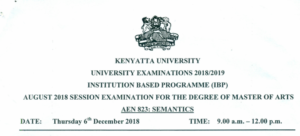
Download Past Paper on Semantics For Revision
ABOVE IS THE EXAM PAPER DOWNLOAD LINK
Where to Find Semantics Past Papers for Download
The search results reveal several authentic sources for downloading Semantics past papers. Most institutional repositories restrict full PDF access to registered students, but the question content provides valuable insight into exam structure and typical topics.
| Source | Institution | Course Code / Notes |
|---|---|---|
| Institutional Repository | NUST (Namibia) | SOS721S – The Study of Semantics. January 2024 supplementary exam paper. The paper has 5 questions testing key topics like hyponymy, synonymy, lexical and structural ambiguity, semantic features, and an essay on how semantics differs from morphology, phonology, and syntax . |
| Institutional Repository | Universiti Sains Malaysia (USM) | HET 311 – Semantics. October/November 2006 exam. This paper features questions on homonymy vs. polysemy, hyponymy vs. meronymy, sentence ambiguity, aspects of semantic knowledge, semantic change (pejoration, amelioration, taboo, euphemism), and speech act classifications (verdictives, expressives, directives, commissives) . |
| Institutional Repository | University of Hong Kong (HKU) | 03260 Semantics. May 1995 B.A. exam. Paper covers topics like negative polarity, deixis, types of ambiguity (lexical and structural), and the interaction of grammatical and lexical aspect. The exam requires answering one question from Section A and one from Section B . |
| Institutional Repository | University of Hong Kong (HKU) | B0205/LING2003 – Semantics: Meaning and Grammar. May 2000 exam. This is an advanced paper with questions on formal logic in semantics, semantic/thematic roles, and cognitive approaches to semantic theory . |
| Institutional Repository | TAR UMT (Malaysia) | BJES2094 – Semantics and Pragmatics. May 2026 examination paper. Restricted access for registered users . An earlier 2023 version is also available . |
| Institutional Repository | PolyU (Hong Kong) | 2703 Semantics and Pragmatics. Second semester, 1997/1998 exam paper. An older but useful resource . |
| Academic Platform | AskFilo (hosts BHU papers) | LNG-202 Semantics. Banaras Hindu University. Papers from 2013, 2022, and 2023 are available . |
| Institutional Repository | CUEA (Kenya) | KMU 508 SEMANTIKI NA PRAGMATIKI. April 2022 exam paper. Kenyan university resource . |
Additional Revision Materials
-
CCSF (City College of San Francisco): A page with 14 review questions on semantics, covering key terms like homonym, antonym, hyponym, deixis, polysemy, and types of ambiguity. Excellent for quick revision .
-
HCMUTE (Vietnam): A final test with suggested answers (answer key) for a Semantics course. Covers concepts like hyponymy and entailment, semantic anomaly, sense relations (synonymy, antonymy, homonymy, polysemy), structural ambiguity, and figures of speech (metaphor, metonymy, simile, hyperbole) .
-
UKM (Malaysia): An exam paper for VC3653 – Semantics from Semester 1, 2001/2002. Access to the file is restricted .
Important Note: When using past papers, ensure they align with your current syllabus. Course content and exam formats can change over time. The most reliable papers are those directly from your university’s official past paper portal or library repository.
Frequently Asked Questions (FAQs) About Semantics Revision
1. What are the major topics covered in Semantics exams?
Semantics exams typically assess your understanding of both theoretical concepts and your ability to apply them to analyze language. Based on a review of numerous past papers, you can expect questions on :
-
Sense Relations: The relationships between word meanings. This includes hyponymy (a specific term under a general category, e.g., rose is a hyponym of flower), synonymy (words with similar meanings, e.g., damp/moist), antonymy (opposites, e.g., deep/shallow), homonymy (same sound/spelling but different meanings, e.g., bank/bank), and polysemy (a word with multiple related meanings, e.g., chip). You may be asked to identify these relations or apply them to word sets .
-
Semantic Features: Analyzing words using binary features like [+animate], [+human], or [+male] to explain why certain sentence combinations create anomaly or contradiction (e.g., “The television drank my water“) .
-
Ambiguity: Understanding the difference between lexical ambiguity (a word with multiple meanings) and structural ambiguity (a sentence with multiple grammatical interpretations). You will often be asked to identify and paraphrase the different meanings of an ambiguous sentence .
-
Deixis: Understanding how certain words (e.g., here, now, I, you) depend on the immediate physical context for their interpretation .
-
Speech Acts: Classifying utterances based on their function (e.g., verdictives, expressives, directives, commissives) .
-
Theoretical Approaches: For more advanced papers, you may be asked about formal logic, cognitive semantics, and key theorists like Wittgenstein .
-
Semantics vs. Other Branches: You might need to write an essay comparing semantics with other linguistic subfields like phonology, morphology, and syntax .
2. What types of questions can I expect?
Past papers show a consistent mix of question formats :
-
Short Answer/Identification: Questions like “Find a hypernym for the following groups of hyponyms” or “What is a synonym for the word homonym?” .
-
Data Analysis: You will be given data (words or sentences) and asked to identify sense relations, pinpoint ambiguity, or explain semantic anomaly .
-
Theoretical Explanation: Questions that ask you to “Explain the contrasts between the (a) and (b) sentences below” or “Outline Wittgenstein’s theory of meaning” .
-
Essay Questions: Longer questions that require a structured response, such as “Discuss what is meant by a cognitive approach to semantic theory” .
3. How can I use past papers to study effectively?
Using past papers strategically is key to performing well on your exam:

-
Simulate Exam Conditions: Time yourself and attempt a past paper without notes. This builds stamina and highlights your weak areas.
-
Practice Data Analysis Questions: A significant portion of semantics exams involves analyzing language data. Practice applying theoretical concepts to new word and sentence examples.
-
Check Your Answers: Use your textbooks, lecture notes, and reliable online resources (like the HCMUTE answer key) to verify your reasoning .
-
Look for Patterns: Review several years of past papers to see which topics appear consistently. Core topics like ambiguity, hyponymy, and semantic features are almost always assessed.
Back to Mpya News Home page: Education, Fashion, Law, business and sports
Last updated on: August 11, 2026
New information gained / new value takehome
- Source Institution Course Code / Notes Institutional Repository NUST (Namibia) SOS721S – The Study of Semantics.
- HCMUTE (Vietnam): A final test with suggested answers (answer key) for a Semantics course.
- Important Note: When using past papers, ensure they align with your current syllabus.
- , bank/bank), and polysemy (a word with multiple related meanings, e.
- Ambiguity: Understanding the difference between lexical ambiguity (a word with multiple meanings) and structural ambiguity (a sentence with multiple grammatical interpretations).
- Theoretical Approaches: For more advanced papers, you may be asked about formal logic, cognitive semantics, and key theorists like Wittgenstein .
- Using past papers strategically is key to performing well on your exam: Simulate Exam Conditions: Time yourself and attempt a past paper without notes.
- Practice Data Analysis Questions: A significant portion of semantics exams involves analyzing language data.
- Practice applying theoretical concepts to new word and sentence examples.
- Check Your Answers: Use your textbooks, lecture notes, and reliable online resources (like the HCMUTE answer key) to verify your reasoning .
This content was developed using AI as part of our research process. To ensure absolute accuracy, all information has been rigorously fact-checked and validated by our human editor, Alex Munene.
External resource 1: Google Scholar Academic Papers
External resource 2: Khan Academy Test Prep
Reference 1: KNEC National Examinations
Reference 2: JSTOR Academic Archive
Reference 3: Shulefiti Revision Materials
Photo credit: instagram.com