In the tech world of 2026, Machine Learning (ML) is no longer just a “buzzword”—it is the engine under the hood of everything from your Netflix recommendations to the diagnostic tools used in modern hospitals. For students in Computer Science, Data Science, or AI engineering, this unit is the “final boss.” It’s where calculus, statistics, and coding collide to create systems that can actually learn from experience.
Below is the exam paper download link
Past Paper On Machine Learning For Revision
Above is the exam paper download link
But let’s be honest: reading about “Stochastic Gradient Descent” is vastly different from being asked to calculate it in a high-pressure exam hall. The gap between theoretical understanding and exam success is often a lack of practice.
This is where past papers become your secret weapon. They pull back the curtain on how examiners think, revealing which algorithms they favor and how they expect you to justify your model choices. To help you bridge that gap, we’ve put together a specialized revision resource with direct access to previous papers.
Mock Q&A: Thinking Like a Data Scientist
To help you get into the “algorithmic” mindset, let’s explore some of the most frequent challenges found in ML exam papers.
Q1: Supervised vs. Unsupervised Learning
Question: “A bank wants to identify fraudulent credit card transactions. Which branch of Machine Learning should they use, and why?”
The Strategy:
-
The Choice: This is a Supervised Learning task, specifically Classification.
-
The Reason: Because the bank has historical data where transactions are already “labeled” as either Fraud or Legitimate. The model learns the patterns of fraud from the past to predict the future.
-
The Twist: Mention that if the bank didn’t have labels and just wanted to find “weird” patterns, they might use Anomaly Detection (a form of Unsupervised Learning).
-

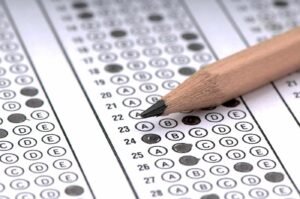
A few blank sheets ready for been filled in a exam.
Q2: The Overfitting Nightmare
Question: “Define ‘Overfitting’ and explain how ‘Regularization’ helps a model generalize better to unseen data.”
The Strategy:
-
-
The Problem: Overfitting happens when a model is so complex that it “memorizes” the training data, including its noise and errors, rather than learning the underlying pattern. It performs perfectly in training but fails in the real world.
-

-
The Solution: Regularization (like Lasso or Ridge) adds a “penalty” for complexity. It essentially tells the model: “Keep the weights small.” This forces the model to be simpler and focus only on the most important features.
Q3: Evaluating Success
Question: “Why is ‘Accuracy’ a dangerous metric to use when evaluating a model for a rare disease diagnosis? What should you use instead?”
The Strategy:
-
The Trap: If only 1% of the population has the disease, a model could simply predict “Healthy” for everyone and be 99% accurate—while being completely useless.
-
The Better Way: You should look at Recall (Sensitivity) or the F1-Score. Recall tells you how many of the actual sick people the model correctly identified. In medicine, missing a sick person (a False Negative) is far worse than a false alarm.
3 Pillars of Machine Learning Exam Success
-
Know Your Math: Don’t just memorize the names of algorithms. Be ready to explain the “Cost Function” and how Backpropagation works in a Neural Network. Examiners love to see that you understand the “Why” behind the “How.”
-
Bias-Variance Trade-off: This is the most common theoretical question. Be prepared to draw the graph showing how model complexity affects both bias and variance. It’s the “Golden Rule” of ML.
-
Preprocessing is King: Many papers will ask you about data cleaning. Don’t forget to mention Normalization, Handling Missing Values, and One-Hot Encoding. A model is only as good as the data you feed it.
Final Thoughts
Machine Learning is a journey of trial and error. It’s about building, breaking, and refining. By working through these past papers, you aren’t just preparing for a test—you are learning the language of the 21st century.
Back to Mpya News Home page: Education, Fashion, Law, business and sports
Last updated on: March 13, 2026
New information gained / new value takehome
- ” The Strategy: The Choice: This is a Supervised Learning task, specifically Classification.
- The Reason: Because the bank has historical data where transactions are already “labeled” as either Fraud or Legitimate.
- It essentially tells the model: “Keep the weights small.
- ” This forces the model to be simpler and focus only on the most important features.
This content was developed using AI as part of our research process. To ensure absolute accuracy, all information has been rigorously fact-checked and validated by our human editor, Alex Munene.
External resource 1: Google Scholar Academic Papers
External resource 2: Khan Academy Test Prep
Reference 1: KNEC National Examinations
Reference 2: JSTOR Academic Archive
Reference 3: Shulefiti Revision Materials
Photo credit: instagram.com